
Standing at the intersection of two fascinating worlds—a mysterious quantum landscape alive with potential and a stable classical reality we rely on day in, day out—leaves us curious about the invisible divide bridging them. This border is where quantum oddities meet the predictable, everyday world.
The Quantum Transition is where this all unfolds, marking the significant passage from the quirky realm predicted by quantum mechanics to the ordered world of classical physics. Imagine quantum particles as energetic revelers at an unending party, flittering from one state to another, embodying the sheer unpredictability of the universe. Where one revels in uncertainty, the other is steeped in unwavering truths—a juxtaposition that invites us to rethink everything we know about reality.
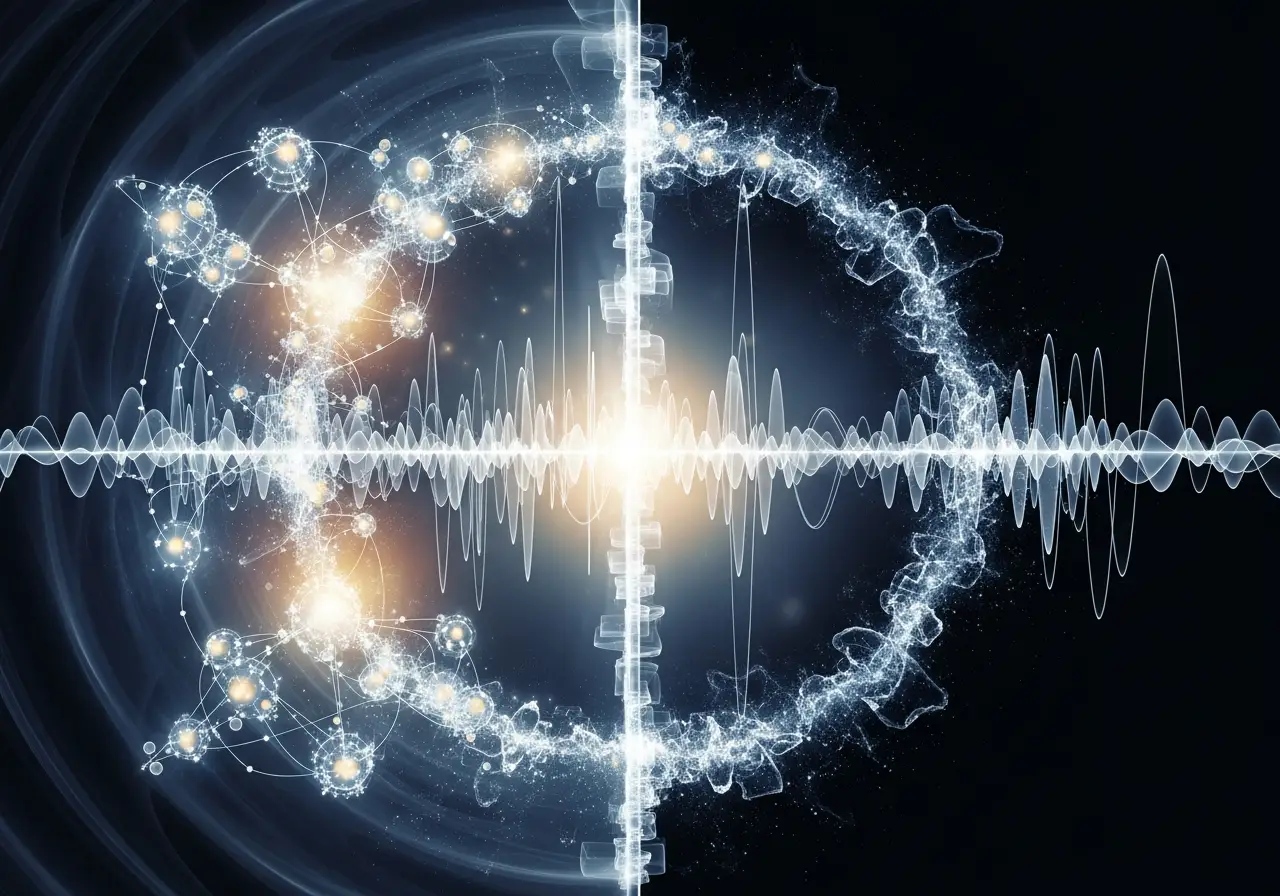
How does this transformative journey unfold? It begins when quantum systems expand and engage with their environment. This interaction prompts decoherence, where quantum entities shed their peculiarities and align with classical norms. This process can be likened to a magic trick unveiled—particles that once spun in uncertain states suddenly assume solid and predictable forms.
Decoherence acts as both a conduit and a challenge—while it ushers quantum states into familiar territory, it also raises profound questions. Why do these systems morph when observed? Is consciousness a player in this transformation? Such quandaries take us to the heart of the quantum-classical shift, enticing scholars to explore the interaction between our awareness and the workings of the universe.
Entanglement, another riveting concept, illustrates a deep-seated connectivity within the quantum world. Here, particles link in ways that defy distance, hinting at an unseen lattice binding us all. While maintaining their quantum essence, these connections inspire us to ponder how they mirror the synchronicities in our own lives.
As scientists uncover more, the measurement problem emerges—a conundrum regarding how observation crystallizes indefinite states into definitive realities. Theories diverge on explanations: the Copenhagen interpretation asserts that observation is integral, while the many-worlds perspective suggests multiverses branching out from each outcome. Both highlight the observer’s role in orchestrating what we perceive as reality.
Each discovery in this domain enhances our grasp of the quantum-classical nexus. Parameters like temperature, pressure, and entropy become pivotal in decoding this transition. With quantum computing on the horizon, we’re witnessing a fusion where the innovative echoes of quantum theory begin addressing classical inquiries.
These revelations impel us to reassess our role—is reality merely unfolding around us, or are we steering the ship? These insights bear the potential to reshape not only our technology but our understanding of existence. The quantum-classical dance offers a vivid tapestry of discovery, urging us to dive into this curious realm and redefine our place in the grand cosmic narrative.