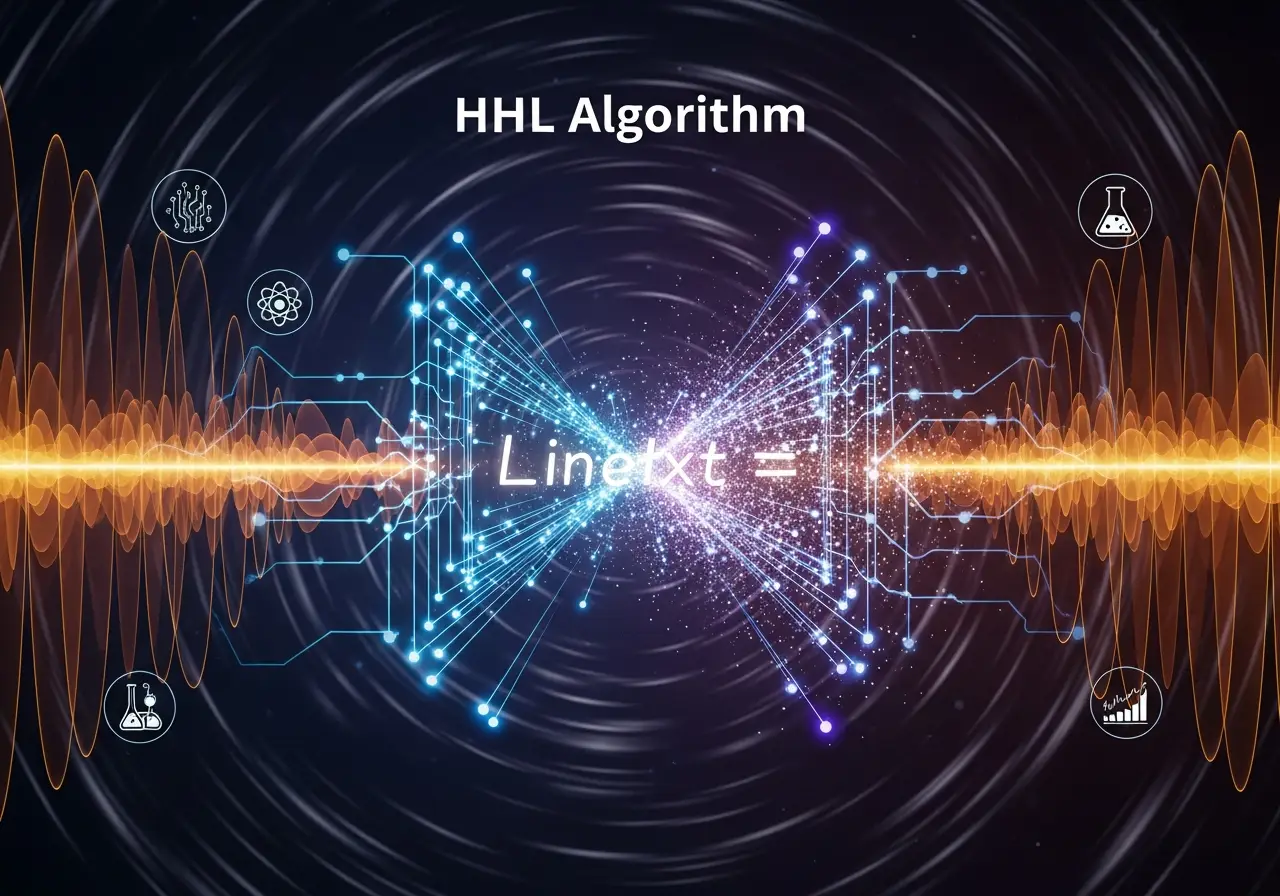

Standing on the brink of something vast can feel overwhelming, especially when it involves the intricate realm of linear equations. These mathematical riddles, while complex, are fundamental to understanding many aspects of our world. That’s where the HHL Algorithm comes into play, offering a fresh approach through quantum mechanics. It’s a solution that not only tackles these equations but reimagines what’s possible in fields like technology and science.
Let’s take a closer look at how it works. Traditional algorithms often require significant time to process large systems of equations, akin to getting stuck in traffic. The HHL Algorithm, however, utilizes quantum principles to cut through this congestion, processing information more efficiently and swiftly than ever before. Imagine it as a team of choreographed dancers, each move calculated and precise, providing solutions with an elegance only quantum computing can achieve.
Quantum computers host qubits, which handle multiple possibilities simultaneously because of superposition. This is in stark contrast to classical computers, which handle tasks one step at a time. As a result, HHL takes what once seemed daunting in linear algebra and makes it manageable, enabling swifter solutions to problems that were previously insurmountable.
The exponential boost HHL provides isn’t just impressive; it’s a fundamental game-changer. Where classical solvers might leave you waiting indefinitely, HHL works at speeds that transform industry standards—from financial modeling to cryptography and beyond.
However, it’s important to acknowledge the hurdles ahead. Qubits, the building blocks of quantum computing, are notoriously sensitive to their environments, which can affect their performance. This means that while the potential is vast, developing the necessary hardware to fully harness HHL’s capabilities is an ongoing challenge.
Ultimately, the HHL Algorithm is more than a step into the future; it’s an invitation to rethink what we know about computation. As we continue to develop and explore quantum systems, the potential to solve complex problems grows ever larger. It’s an exhilarating time, where mathematicians and technologists alike can push boundaries further than they might have imagined before. By embracing this breakthrough, we open the door to unprecedented possibilities. For those eager to dive deeper into technological advances like this, take a moment to explore [Firebringer AI](https://firebringerai.com).