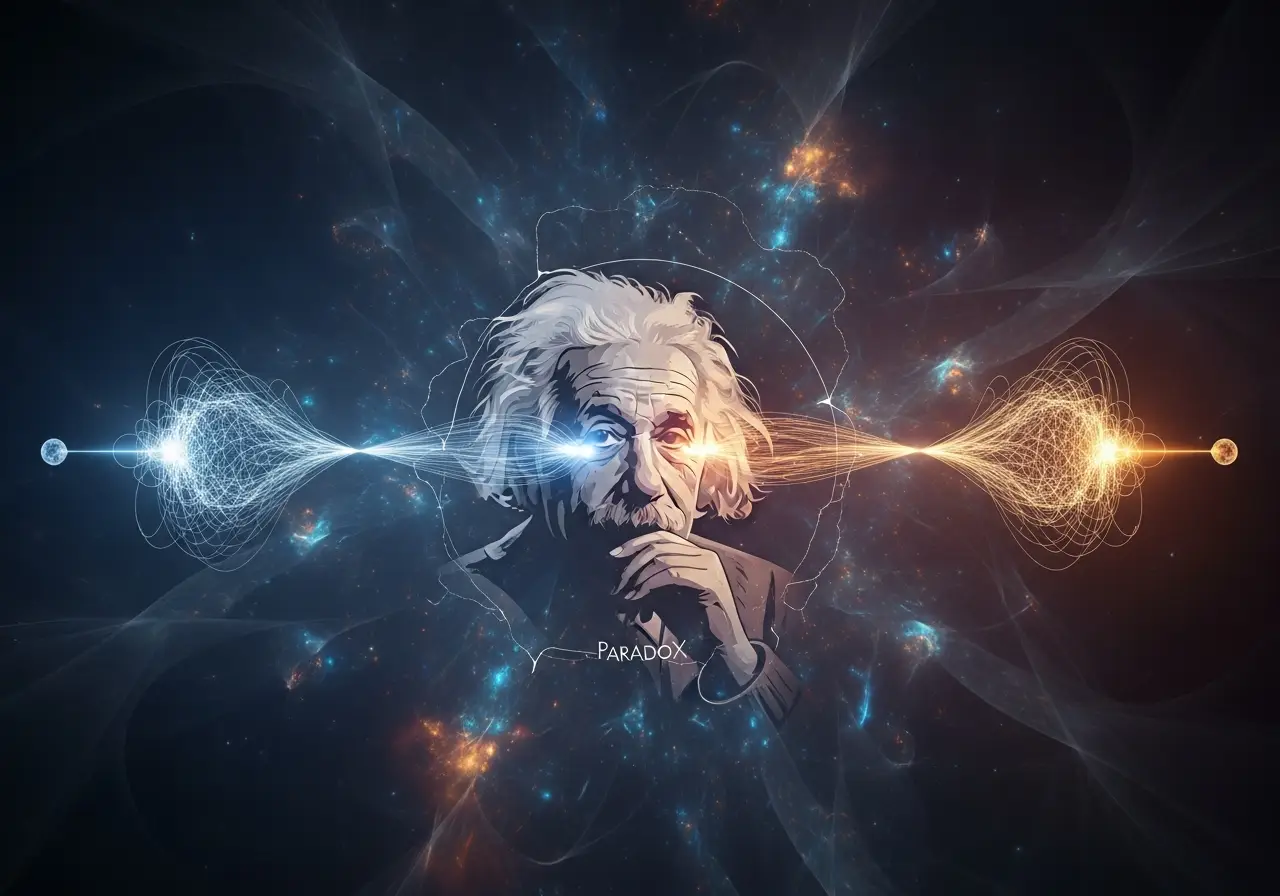

Imagine, if you will, two particles that defy the conventional limitations of space and time—separated by unimaginable distances, yet still bound by an inexplicable bond. This is not a flight of fantasy, but a phenomenon within the realm of the Einstein-Podolsky-Rosen (EPR) Paradox, a puzzle that has intrigued and vexed the minds of physicists for decades. This thought experiment pokes at the very heart of what we understand about reality itself. Could it be that this perplexing paradox is more than a theoretical conundrum? Might it be a doorway to uncovering the hidden order that underlies our universe?
The roots of the EPR Paradox trace back to 1935 when Albert Einstein, along with colleagues Boris Podolsky and Nathan Rosen, cast doubt on the completeness of quantum mechanics. Their inquiry questioned if the description provided by quantum theory was sufficient, suggesting instead that hidden variables might be at play—crafting the behavior of particles in a deterministic universe. In Einstein’s view, the notion of “spooky action at a distance” where measuring one particle could somehow affect another light-years away, seemed implausible.
Since then, the EPR Paradox has not simply sat idle in the annals of quantum theory; it has been a catalyst for deeper exploration into the enigma of entanglement. The way entangled particles showcase a form of instant communication challenges our classical perspectives on space and time. Unlike our everyday experiences where messages require physical travel, entangled particles appear to defy these limitations, transferring information instantaneously irrespective of distance—shaking our understandings of causality to their core.
Today’s experimental advancements have done much to validate entangled phenomena, largely thanks to the pioneering work around Bell’s theorem. This theorem provides a framework for testing the EPR concerns against quantum mechanics predictions. Experimental results overwhelmingly suggest that no hidden variables are pulling the strings behind the scenes; instead, entanglement is an intrinsic part of how our universe operates. This raises fascinating questions about the interplay between measurement and the very nature of reality.
These insights hint at a profound interconnectedness of everything in existence—challenging us to ponder questions that once seemed confined to philosophy or mysticism. What if observation itself is a driving force in shaping reality? This idea nudges us into contemplating the relationship between consciousness and the quantum world.
The implications of the EPR Paradox call us to reconsider our place within the cosmos. These entangled mysteries encourage us to wonder if our actions and perceptions echo broader than we perceive, potentially influencing the universe in subtle, yet significant ways. This exploration is not limited to scholars and scientists; it’s a call to anyone curious about the vastness of possibility—inviting us to stretch our minds to engage with the strange and beautiful complexities of existence.
The EPR Paradox is a gentle reminder that reality may hold more nuance and wonder than our traditional narratives suggest. As we stand at this crossroads of discovery, we are invited to move beyond skepticism and embrace curiosity, recognizing that each of us contributes to this unfolding story. The tapestry of existence weaves together measurable realities and boundless mysteries—unveiling a universe that is both familiar and wondrously strange.