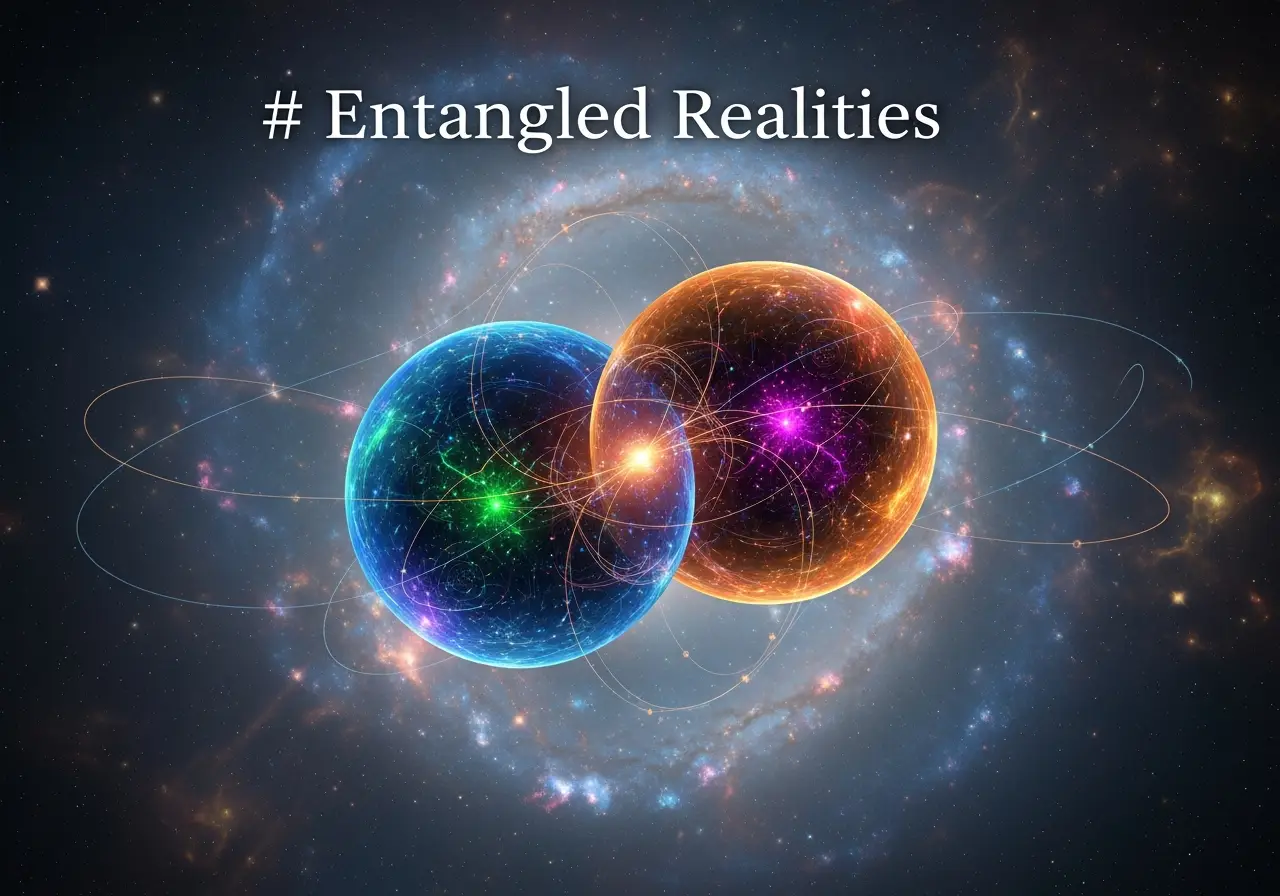

Imagine being in a universe where two particles, despite being light-years apart, instantly share their states. This is not science fiction—it’s the core of the Einstein-Podolsky-Rosen (EPR) paradox, a thought experiment that has fundamentally challenged our understanding of quantum mechanics.
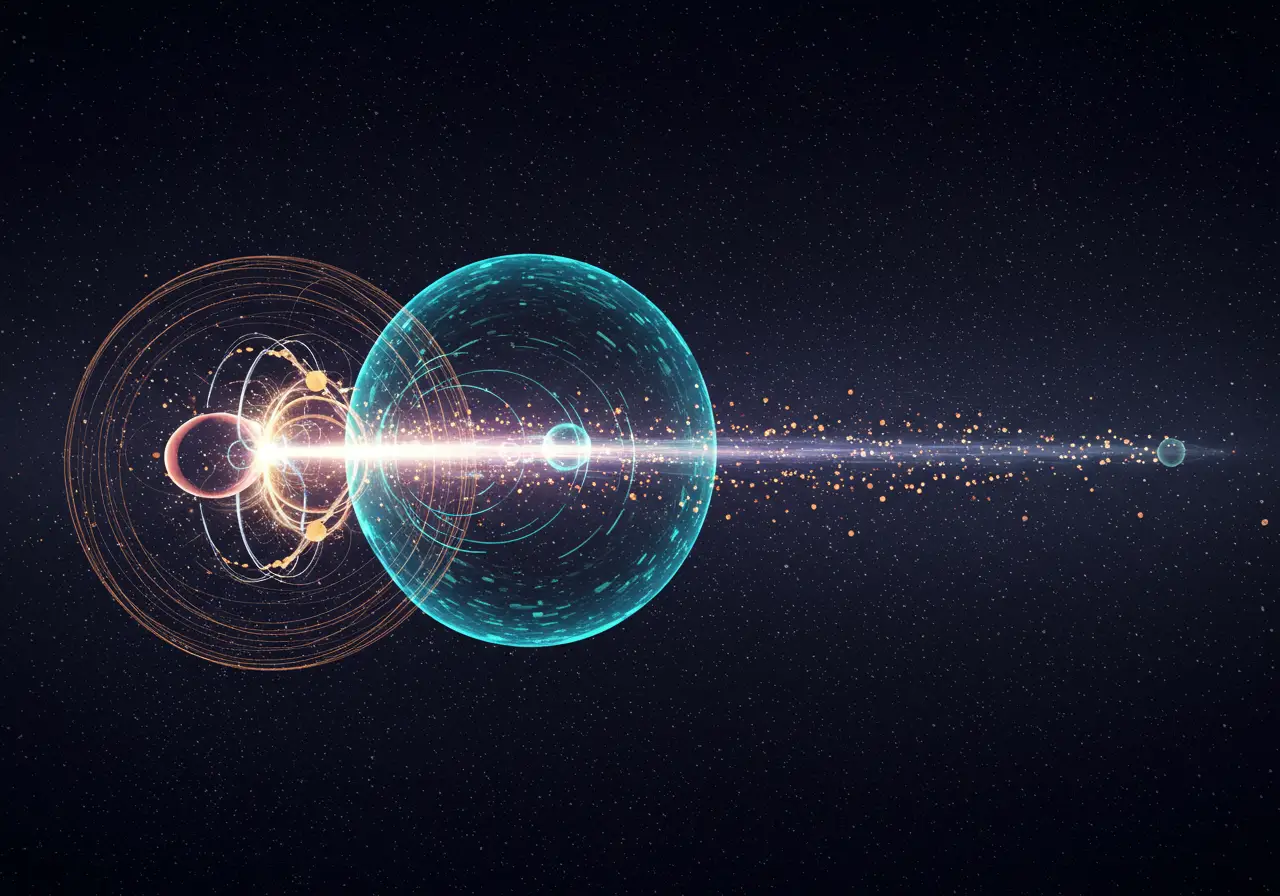
Einstein and his colleagues posed this intriguing paradox to question whether quantum mechanics could truly offer a complete picture of reality. At its heart, the EPR paradox presents a scenario of entangled particles whose behavior seems to defy our intuitions about space and time. Imagine one particle near a distant star and another in your backyard; when one changes its spin, the other does so simultaneously. It’s as if a mysterious bond connects them, influencing each other faster than the speed of light—something Einstein famously dubbed “spooky action at a distance.”
This paradox was an effort to highlight what the originators saw as potential gaps in quantum mechanics. They speculated that there might be hidden variables—undiscovered factors that could explain these peculiar interactions in a way that classical physics could embrace. However, experiments and theories developed over the decades, such as Bell’s Theorem, have largely supported the quantum view, suggesting that if hidden variables exist, they do not operate in the straightforward ways initially imagined.
The EPR paradox doesn’t just challenge scientific mechanics; it invites philosophical inquiry into the very nature of reality. It raises the possibility that classical separateness—our view of distinct, independent objects—is perhaps an illusion. Instead, it suggests a universe where everything is interconnected in ways that go beyond our current understanding.
The pursuit to resolve this paradox has pushed scientists toward newer theories, where distinct fields like science and philosophy begin to intersect. Instead of seeing the universe as a collection of independent entities governed solely by laws, these ideas propose a more integrated system. It invites us to consider a universe where connections and relationships play a crucial role in its fabric.
Ultimately, the EPR paradox not only challenges traditional physics but also inspires us to rethink our place in the cosmos. In embracing its mysteries, we participate in an ongoing journey to understanding, reflecting the rich and interconnected tapestry of existence. So as we contemplate these profound ideas, let’s remain open to the possibility that reality is both more complex and more unified than we ever dreamed.