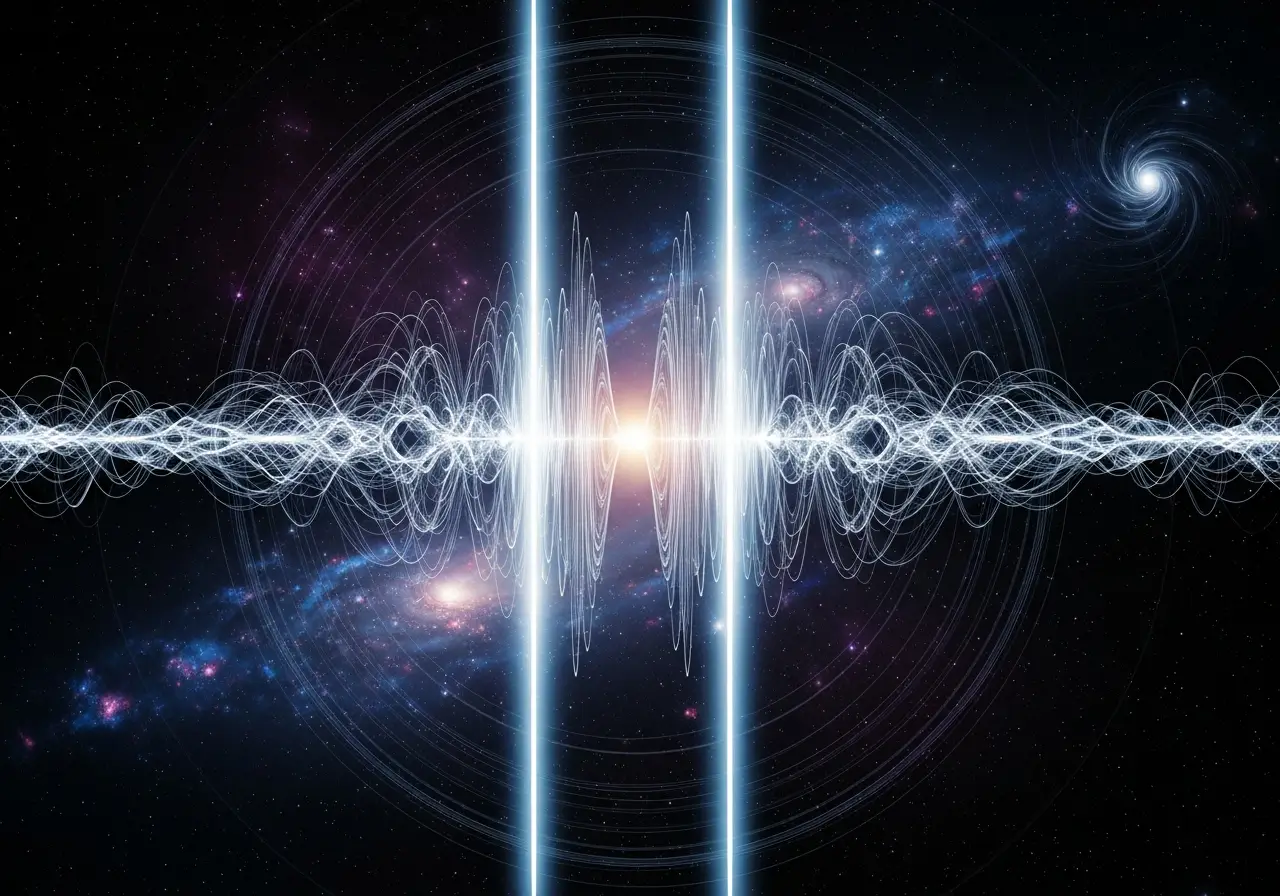

Imagine you’re on the brink of a place where the rules you know waver and dance—a realm introduced by the Double-Slit Experiment. This experiment throws you headfirst into the quirky world of quantum mechanics, where light defies straightforward categorization as just a wave or a particle. In this experiment, two tiny openings become gateways to a world that reshapes your basic understanding of existence.
As particles like photons or electrons stream through these slits, they form patterns that seem to mock our intuitive grasp of reality. These patterns emerge even when particles travel one by one, seemingly implying that each behaves as a wave, interfering…with itself. This isn’t just a curious quirk; it’s a reminder that reality may not be as static as we think—possibly a fluid interplay where observation isn’t passive watching, but an active shaping force.
Consider the Observer Effect, where simply watching the particles alters their dance, stripping away their wave-like disguise and forcing them into the mundane mold of particles we expect. In a way, consciousness—or the act of observing—seems to flick the switch between different states of being. This raises tantalizing questions about the role of awareness in the very fabric of reality.
What if we imagined these particles as performers in a vast cosmic show? When unobserved, they pirouette freely on the stage, embodying their wave persona. But introduce an observer, and they snap back into regimented ranks, playing their particle roles to perfection. Such antics suggest that the universe might have a playful streak—a reminder that even at the tiniest scales, the cosmos has a sense of humor.
The Double-Slit Experiment isn’t just a puzzle of physics—it’s a reflection on how the universe itself might operate. If every thought and intention bears weight, maybe we’re not just spectators but co-authors of reality. This notion stretches the mind, inviting us to think of reality not as a spectator sport but as a collaborative creation.
In our everyday lives, might our thoughts and emotions ripple out like the particles in this experiment, influencing the reality we step into? It’s a subtle invitation to consider how the energies we project could ultimately sculpt the world we inhabit. Our awareness and intentions could dance with possibility—shaping our reality in ways we’re only beginning to understand.
Through all this, the experiment beckons us to question the dynamic between observer and observed, the dance between consciousness and reality. What shifts, one wonders, when we acknowledge our active role in this cosmic choreography?
So as you reflect on these quantum mysteries, remember: your perception does more than look upon reality—it’s part of its creation. Consider this not just an experiment but a symbol, nudging us to engage with our role as participants in this grand design. It’s a prompt to recognize how closely intertwined our consciousness is with the universe—a bond that gives rise to possibilities as vast as the cosmos itself.