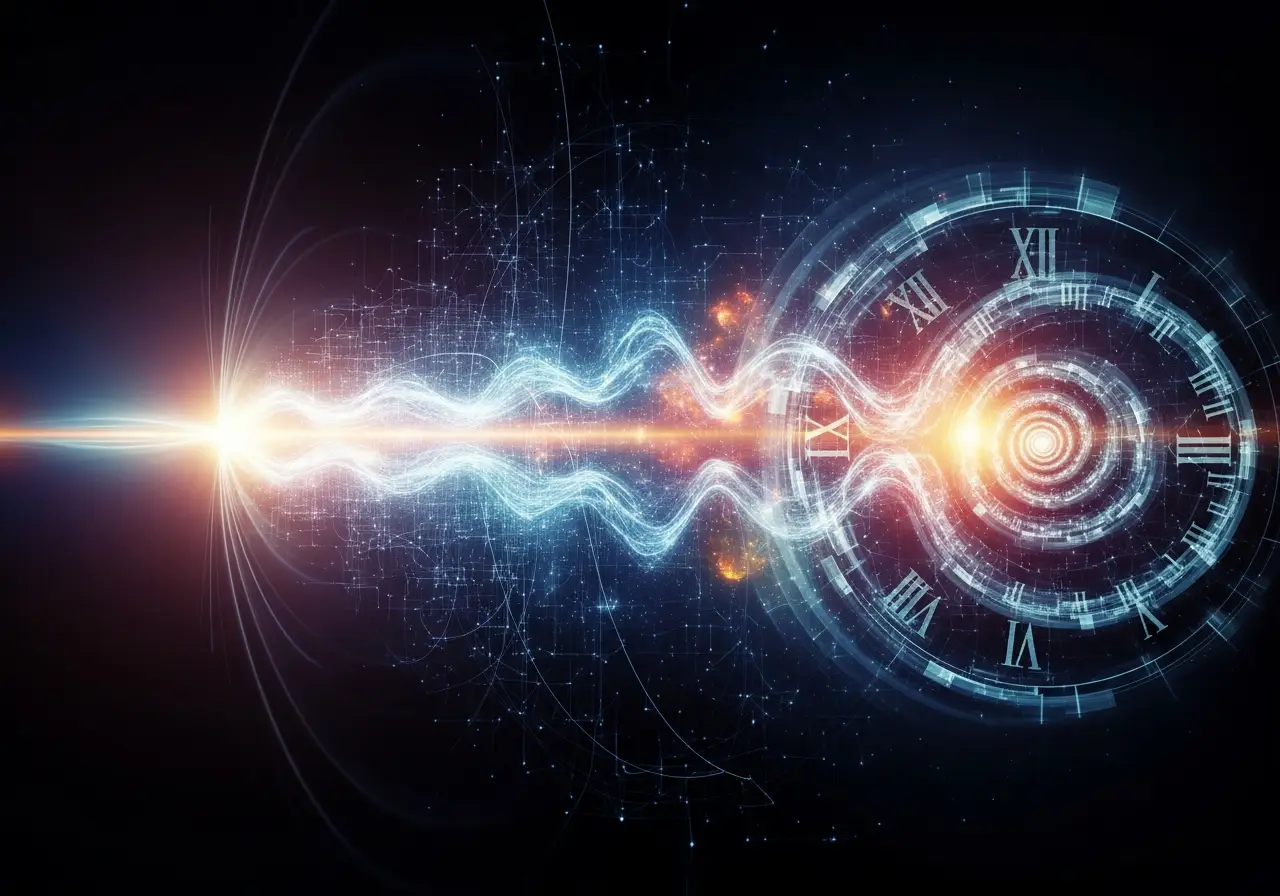

Let’s dive into a world where our established understanding of light speed takes a curious turn. Traditionally clocked at close to 299,792 kilometers per second in a vacuum, light was long viewed as the universe’s ultimate sprinter. But here’s the twist: when light encounters certain materials, like specially prepared gases or carefully constructed photonic crystals, its pace slows significantly, behaving more like a leisurely stroller than a supercar.
Imagine scientists harnessing these processes, allowing them to slow light to just a few meters per second. Think about flicking off a light switch, only to witness the room remain illuminated for a moment longer, as if light itself were savoring its last dance. But why does this matter? The potential applications are nothing short of transformative.
Consider a future where communication is refined not by faster transmission but by controlled precision through slow-light media. Imagine quantum signals weaving gracefully through this medium, defying current bandwidth constraints and redefining data transfer. It’s like a symphony of information flowing seamlessly, where technology meets artful dance.
This manipulation of light also opens doors to pioneering technologies in computing and encryption. Computers could leverage slow-light techniques to calculate at extraordinary rates while ensuring signal security, adding layers of complexity that make attempts at hacking seem almost trivial. With such advancements, new computing paradigms could emerge, making classical computing limitations seem like relics of the past.
The philosophical ruminations are equally captivating. Our perception of time, often dictated by the speed at which light reaches us, could undergo a profound shift. When we control light’s tempo, we touch upon the very fabric of reality, inviting fresh interpretations of time’s passage and our place within it. Imagine each moment teasingly elastic, as if the universe itself were whispering secrets of a broader existence beyond linear time.
Moreover, this exploration beckons beyond technological advancements, touching on some of astronomy’s greatest mysteries. Could slowing light reveal hidden secrets about dark matter or energy? As we decelerate photons, might our observations of the cosmos gain newfound clarity, offering insights previously beyond our grasp?
The journey into slow light isn’t just about generating a scientific novelty; it’s a call to rethink how we see our universe. It invites us to challenge cosmic norms and embrace the open-ended nature of exploration. So, as we delve into this intriguing frontier, prepare for a tapestry of discovery that stretches both our understanding and imagination—offering a glimpse into a slowed yet richer universe.