
Picture a world where tiny particles slip through barriers that seem impossible to cross, changing our fundamental understanding of reality. Welcome to the captivating realm of quantum tunneling, where atoms defy classical physics and find pathways through seemingly solid walls. In this fascinating dance, radioactive decay introduces us to alpha decay, a phenomenon that challenges our perception of time, space, and the forces that bind matter. Let’s delve into the quantum universe, exploring how these elusive particles tunnel through barriers, revealing the secrets at the heart of our existence.
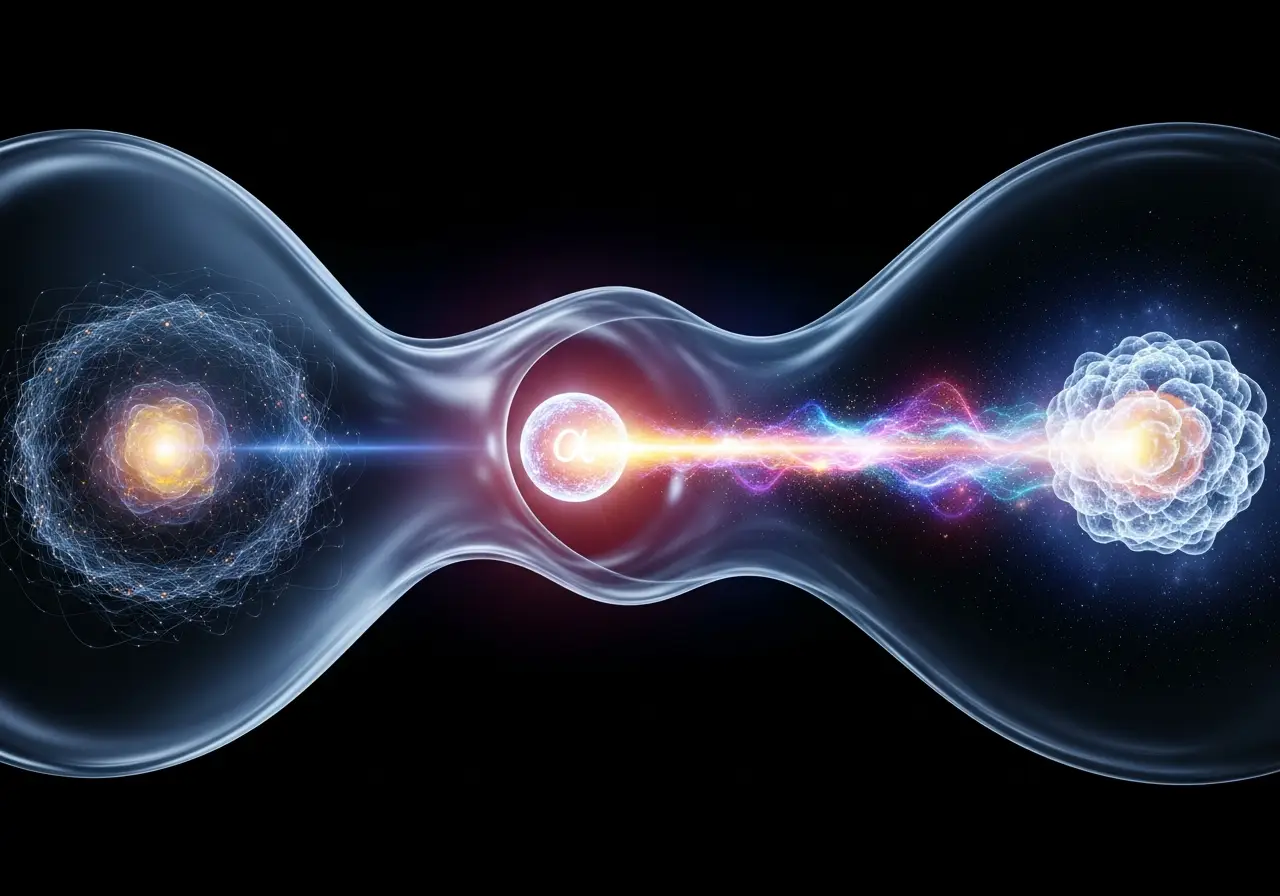
Imagine an atomic nucleus as a tightly packed space where energetic protons and neutrons move along to the rhythm of the strong nuclear force holding them together. Sometimes, when unstable nuclei tire of the party, some protons and neutrons wish for freedom—an escape from the high-energy state that traps them. But rather than being stuck, these particles engage in quantum tunneling, moving through barriers like an artful leap over an insurmountable wall.
Alpha decay acts as a small-scale spectacle within this cosmic scenario. When a nucleus prepares to emit an alpha particle—a combination of two protons and two neutrons—it encounters an energy barrier, an apparent obstacle to freedom. Classical physics might declare such an escape impossible, but quantum mechanics offers a surprising solution: particles can tunnel through the barrier, defying traditional constraints.
This phenomenon isn’t merely theoretical. Alpha decay offers us glimpses into the very processes that shape the universe. Through this process, unstable isotopes transform, creating new elements and driving the creation of stars. This cosmic recycling program of sorts speaks volumes about the lifecycle of atoms and the interconnectedness of the universe.
Exploring quantum tunneling and alpha decay, we uncover particles existing as both waves and distinct entities. This dual behavior, known as superposition, allows particles to be in multiple states simultaneously until observed. It’s an illustration of quantum mechanics’ inherent complexity and unpredictability, guiding our understanding of the universe from a fresh perspective.
Alpha decay, within this framework, is a stark reminder that barriers aren’t always solid; they often serve merely as suggestions. This dance of quantum particles encourages us to embrace the strange nature of quantum mechanics, asking us to consider what hidden depths of reality are left unexplored.
So, when pondering the atomic building blocks of nature or new insights from quantum mechanics, remember the daring alpha particle slipping through barriers and redefining the possible. In this quantum space, filled with potential, we are prompted to challenge conventions, push limits, and appreciate the blend of science and wonder. This mesmerizing dance reminds us that reality is an ever-evolving tapestry, echoing the rhythms of the cosmos and inspiring us to explore the boundless possibilities of our own journeys.