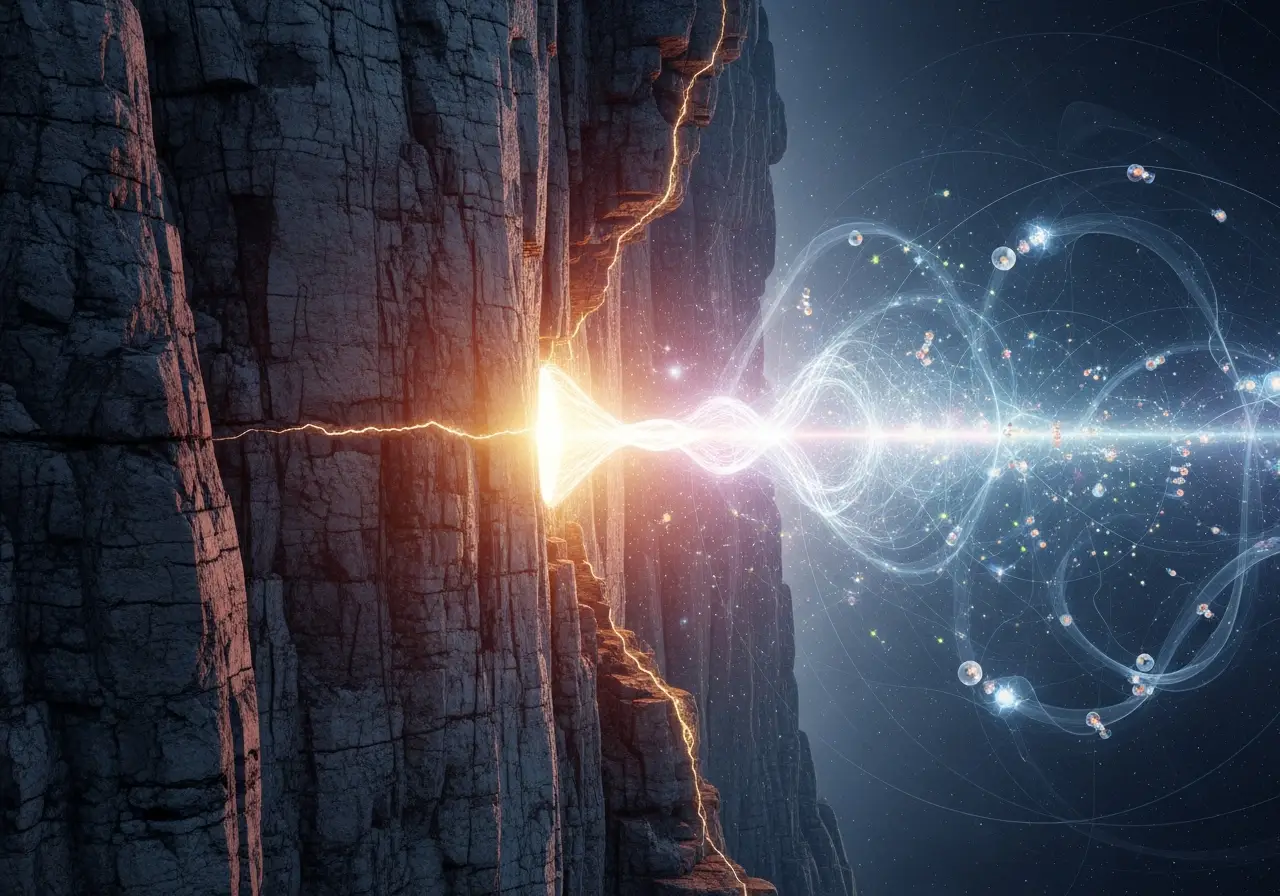

Quantum tunneling is a fascinating concept that defies our conventional understanding of reality. Unlike our daily experiences, where solid barriers are unpassable, in the quantum realm, particles can appear on the other side of obstacles without brute force. This occurs in processes like alpha decay, where an unstable nucleus releases an alpha particle—comprised of two protons and two neutrons—through this counterintuitive yet mathematically sound phenomenon.
In essence, alpha decay does not follow the straightforward path of exerting enough energy to overcome a barrier but rather relies on the probabilistic nature of quantum mechanics. Picture it as a game of chance where the odds—aided by the wave-like properties of particles—allow the alpha particle to escape as if the barrier was never a hindrance at all. This ‘shortcut’ through the seemingly impossible becomes possible when we consider the nucleus as a part of a quantum ensemble operating in harmony.
Understanding this process sheds light not only on fundamental aspects of physics but also on broader applications, from nuclear energy production to cosmic phenomena. As we delve deeper into the implications of such quantum behaviors, we also reflect on our own lives. The capability of particles to traverse barriers prompts us to question the limitations we accept in our personal journeys. What mental or societal barriers might we overcome if we, too, embraced the potential for change?
As we explore further, the mysteries of quantum physics continually expand the frontiers of scientific knowledge. Each discovery holds the promise of transforming technology and inspiring us to rethink the boundaries of what’s possible. By peering into this quantum world, we engage not only with the complexities of the universe but also with our capacity to redefine those boundaries in our lives. This journey encourages us to embrace uncertainty, cultivate curiosity, and remain open to the wonders that await in both science and personal growth.