
Let’s break down this intriguing concept called Orch-OR theory and understand it in a way that feels more like a story unfolding rather than an abstract scientific exploration. The idea, pioneered by Roger Penrose and Stuart Hameroff, merges two worlds: our conscious mind and the enigmatic dance of quantum mechanics. Picture your thoughts as threads in a vast cosmic tapestry—each thread a potential reality, waiting to be woven by an unseen force. This isn’t just about observing—it’s about gravity stepping in as an unseen orchestrator, gently guiding which potential thread becomes part of the fabric of reality.
Now, visualize those tiny, bustling components inside our cells known as microtubules. They could be more than just scaffolding; they might be processing units for thought! Within them, a delicate balance governed by gravity might spark the transformation of quantum possibilities into tangible realities. Think of gravity as a maestro, conducting an invisible symphony where every note contributes to the grand composition of existence.
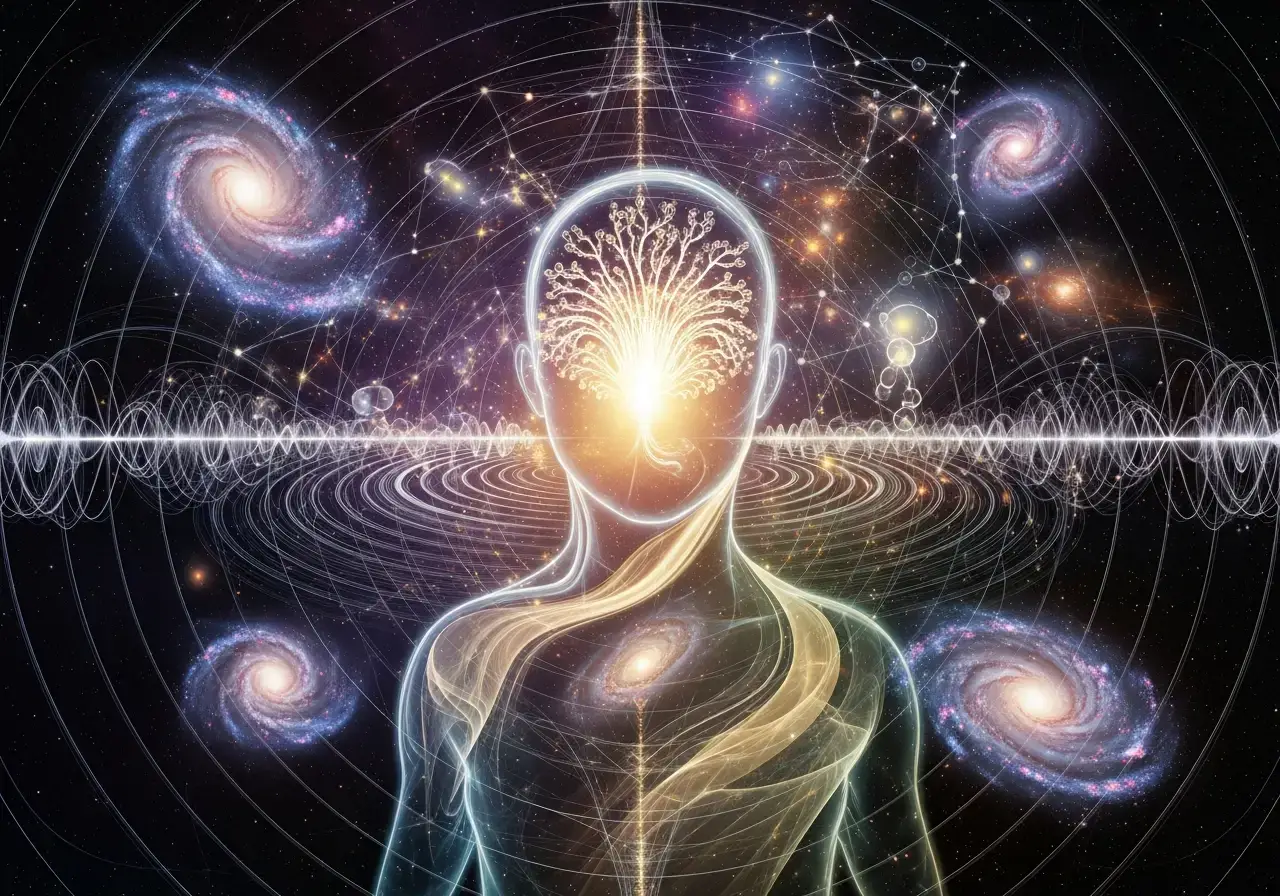
This theory challenges us to rethink the essence of consciousness. Are our thoughts merely by-products of brain activity, or are they intimately woven into the universe’s very fabric? Imagine consciousness not as an isolated phenomenon, but as something embedded within the cosmos—like gravity itself. It’s like seeing the universe come alive with thought, each quantum collapse akin to a new verse in a cosmic song.
By considering this perspective, we open up the possibility that all forms of life, from the simplest organisms to the sprawling galaxies, might be dancing to the gravitational rhythms guiding quantum states. This interconnectedness might even extend beyond natural life—prompting us to reevaluate how we perceive artificial intelligence and its potential to participate in this dance.
As you sip your coffee, gravity isn’t just keeping it in your cup; it’s orchestrating the warp and weft of reality, entwining with your consciousness. Orch-OR invites us to explore this symbiotic relationship and reflect on the universe as more than a backdrop for our existence, but as an integral partner in the dynamic evolution of thought and reality.
The adventure lies not only in understanding these concepts but also in considering their implications. How do they reshape our understanding of life, the cosmos, and the potential for intelligence beyond our own? Consider this a starting point in a grand conversation about who we are, where we come from, and how deeply woven into the universe we might truly be.