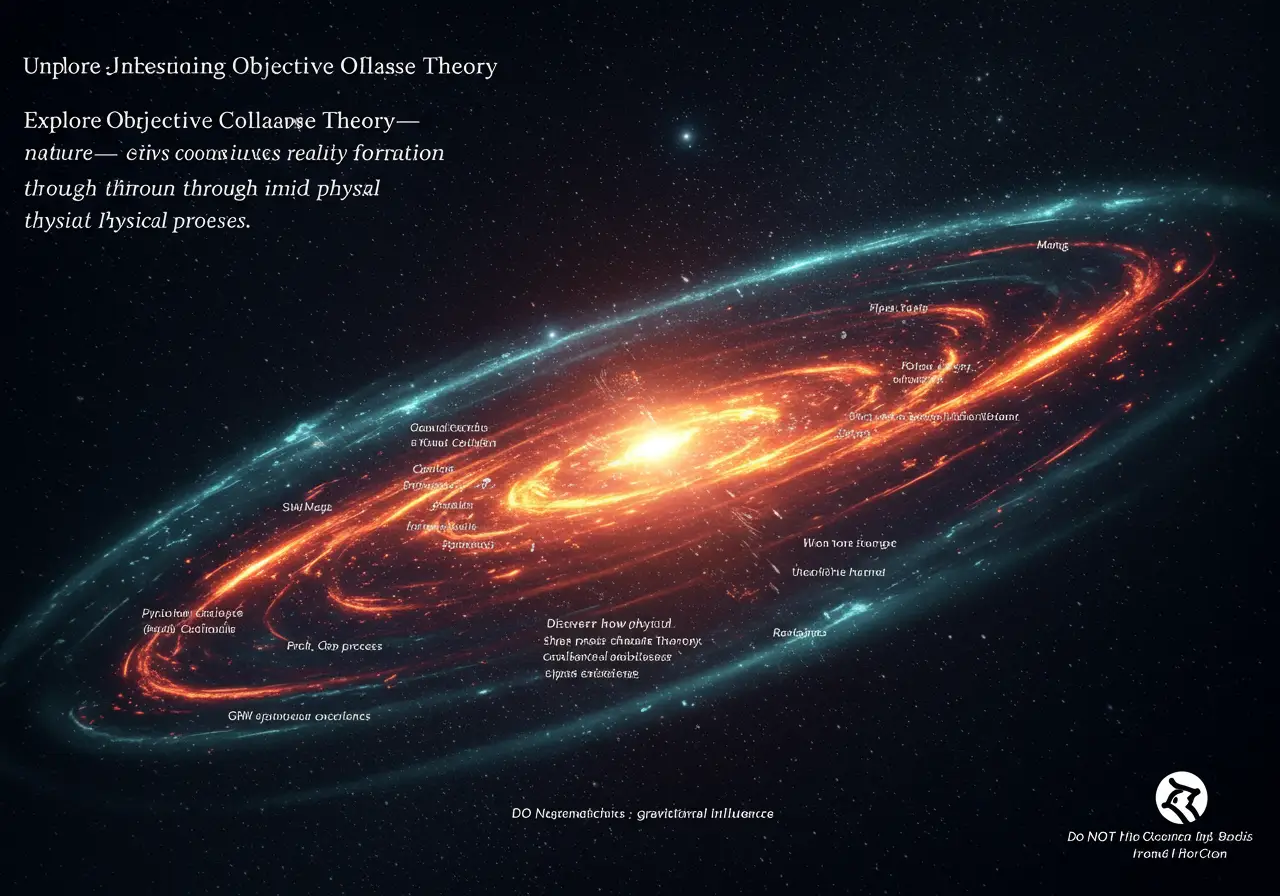

On the brink of exploring reality’s deepest layers lies the intriguing concept of Objective Collapse Theory. This idea challenges the traditional view that consciousness alone shapes the universe. Instead, it suggests that inherent physical processes drive the transition from potential to actual existence. It’s as if nature itself has a hand in determining what becomes real, independent of human observation.
In this framework, spontaneous collapse takes center stage. Imagine particles—those building blocks of everything—undergoing random collapses due to their mass or energy. Reality isn’t just out there waiting for a mindful gaze; it’s constantly unfolding through mechanisms rooted in the universe itself. It’s like being at a musical performance where the conductor decides the harmony, guiding particles to move from uncertainty to form.
Gravity adds another layer to this story. Some interpretations speculate that it may contribute to these collapses, acting like a universal disciplinarian steering particles back on course when they stray. Larger masses exert more influence, while smaller ones drift around like aimless wanderers, waiting for gravity’s firm direction.
The GRW model presents an alternative view, suggesting that unpredictable moments cause sudden collapses, aligning our chaotic quantum world with the ordered reality we know. Imagine life as a series of unexpected moments that somehow, in hindsight, fit neatly into the grand puzzle of existence.
What does this mean for us as observers? It turns the focus away from solely human-centric experiences, proposing that the universe’s rules play a fundamental role, no matter who—or what—is doing the watching. This realization invites us to rethink our understanding of reality, suggesting that the universe operates independently, patiently adhering to laws that wait to unfold at just the right moment.
Objective Collapse Theory also hints at bridging the gap between quantum mechanics and relativity, suggesting that cosmic processes like gravity could serve as a unifying force. Contemplating such profound connections can reshape our understanding of how the universe operates on both a grand and minuscule scale.
Reflecting on this expansive view, we find ourselves positioned not just as casual observers, but as participants in a profoundly interconnected universe. This realization challenges us to embrace a deeper connection to the world, recognizing the dynamic interplay of forces that shape our reality. It’s a humbling yet exhilarating thought that invites us to appreciate the intricate dance of existence—beyond what we merely see, and into the very essence of the cosmic journey itself.