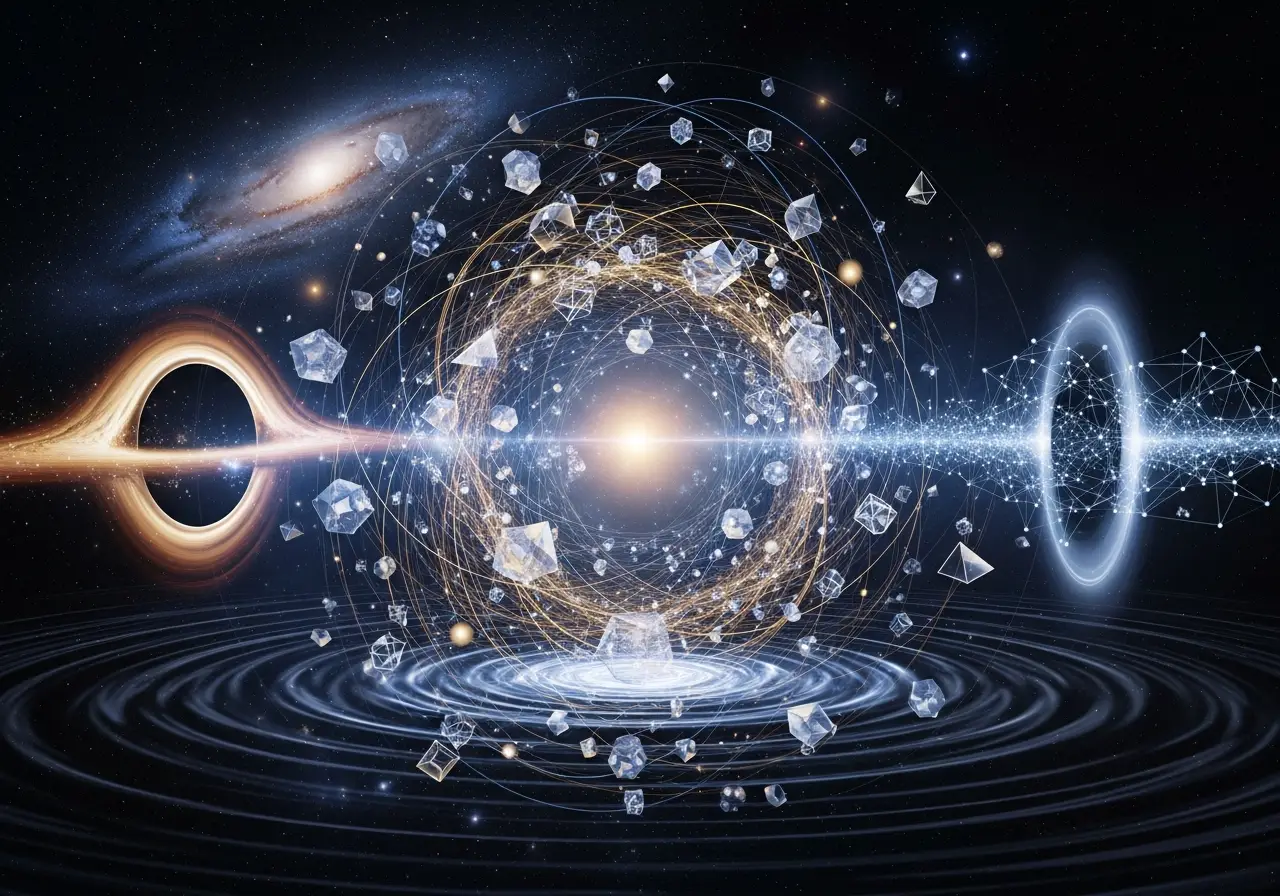

The essence of reality often seems tangled in a web of uncertainty, and at the core of this enigma lies what many physicists call the Objective Collapse theory. Imagine particles existing in a state of potential, driven to reality not by observation but by intrinsic processes that forge them into defined states. This isn’t mere theory; it’s a pivotal piece in understanding why the universe often defies predictability.
At its heart, the Objective Collapse challenges the classic view that particles only resolve into one state when observed. This traditional concept suggests reality hinges on observation—a notion that this newer theory turns on its head. What if particles could self-determine into definitive states, driven by their intrinsic properties and processes like gravity or particle interactions, without needing a conscious observer?
In models like the GRW (Ghirardi–Rimini–Weber), particles randomly collapse into definitive states. Picture it like a hidden force creating ripples in a still pond, determining where things settle. It implies a universe that operates on its own principles, independent of human intervention.
While randomness plays a role, Objective Collapse is underpinned by elegance. Consider gravity’s role; as particles move closer, their gravitational field might catalyze collapse, suggesting gravity as an active participant in quantum reality, not just a backdrop.
Decoherence—the loss of quantum superposition through environmental interaction—adds another layer. Imagine an ice cream sundae melting; it starts with boundless potential, but environmental factors drive it into a singular, albeit melty, state. Similarly, decoherence hastens the shift from potential to reality.
Investigating Objective Collapse isn’t just academic; it has real implications. Consider black holes and information loss. If particles can self-collapse, could this mean black holes unpredictably affect quantum states? It forces us to rethink foundational concepts in physics.
Grasping Objective Collapse can indeed be complex, like untangling a convoluted knot. But each resolution brings us closer to understanding our universe. This theory invites us to view the universe not just through a lens of observation but through intrinsic, interconnected processes.
As you ponder the universe, consider the forces shaping reality beyond mere observation. Engage with this cosmic dance not just as an onlooker but as part of a grand narrative. Welcome to the intricate world of Objective Collapse, where each interaction moves us closer to understanding the vibrant enigma of life.