
Picture yourself at the brink where quantum physics teases with its oddities, while classical laws stand firm. Here lies an intriguing truth: coherence—a delicate strand knitting the unpredictable quantum with the orderly classical. This isn’t just a concept to ponder; it beckons a rethink of how we grasp the universe and our role within it. Let’s wander into this profound connection, where understanding coherence might unlock new realities of our existence.
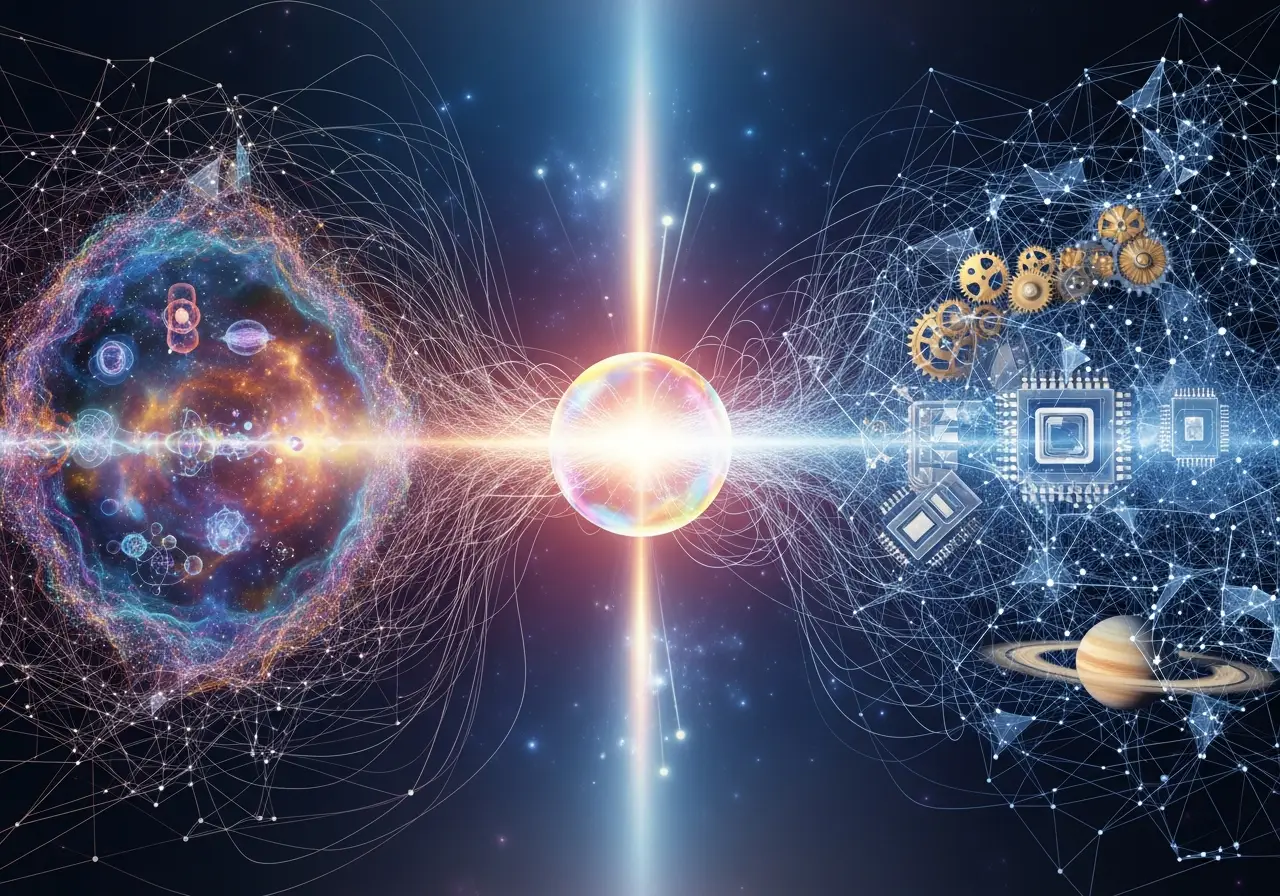
At the heart of this idea is coherence. While quantum physics can seem puzzling—particles in superpositions or entangled states—coherence serves as a bridging concept. It harmonizes the erratic with the predictable, offering impactful insights for technology, consciousness, and space-time itself. Imagine coherence as a meticulously designed bridge that allows erratic quantum behaviors to meld with our classical perceptions of motion and force.
Consider quantum phase transitions where coherence plays a pivotal role as systems shift phases. This synchronicity among particles isn’t just background noise; it actively shapes the course of reality. This dance of coherence unveils wonders in fields like materials science and quantum computing, and even how we might understand phenomena as profound as black holes.
The practical implications of coherence are undeniable, especially in the realm of quantum computing. Unlike their classical counterparts, quantum computers leverage coherence to handle complex problems—an evolution that might change how we perceive computational tasks. These quantum bits or qubits, thanks to coherence, can tackle multiple operations simultaneously, heralding a new dawn in computing potential.
But coherence isn’t merely a tool for technology; it nudges us toward deeper philosophical inquiries. Could coherence be a reflection of consciousness reaching into the quantum fold? Do meditation and focused intention mirror a coherent state aligning us with the universe’s tapestry? Such questions suggest consciousness intertwined with quantum behavior, hinting at our influence over reality—a tantalizing thought, indeed!
Yet, the journey isn’t without hurdles. Transitioning between the quantum and classical realms poses challenges, particularly fighting decoherence, which disrupts the delicate balance needed for quantum efficiency. Overcoming these obstacles sparks innovation, driving us closer to realizing a seamless quantum-classical continuum.
In essence, exploring coherence’s role in bridging quantum and classical physics invites us into the fabric of existence itself. As we traverse these boundaries, we see the stories we tell—and those we live by—transform, revealing a reality where consciousness is an integral part of the cosmic chorus.
Now, on the verge of this deeper understanding, we must decide whether to plunge into these depths or merely skim the surface. What we find in our exploration of coherence could reshape our reality and encourage us to view our thoughts and actions as integral to the universe’s unfolding saga. It’s a journey into the heart of existence, where coherence invites us to rethink limits and embrace potential—a cosmic story unfolding with each coherent pulse.