
In contemplating Orch-OR theory, let’s step back and challenge some deeply entrenched ideas about the nature of consciousness and reality. Traditionally, our physical world has been described through the lens of the “observer effect,” where simply observing a phenomenon can determine its outcome. But what if instead of observation, it is gravity itself—a typically invisible force—that shapes the very essence of our universe?
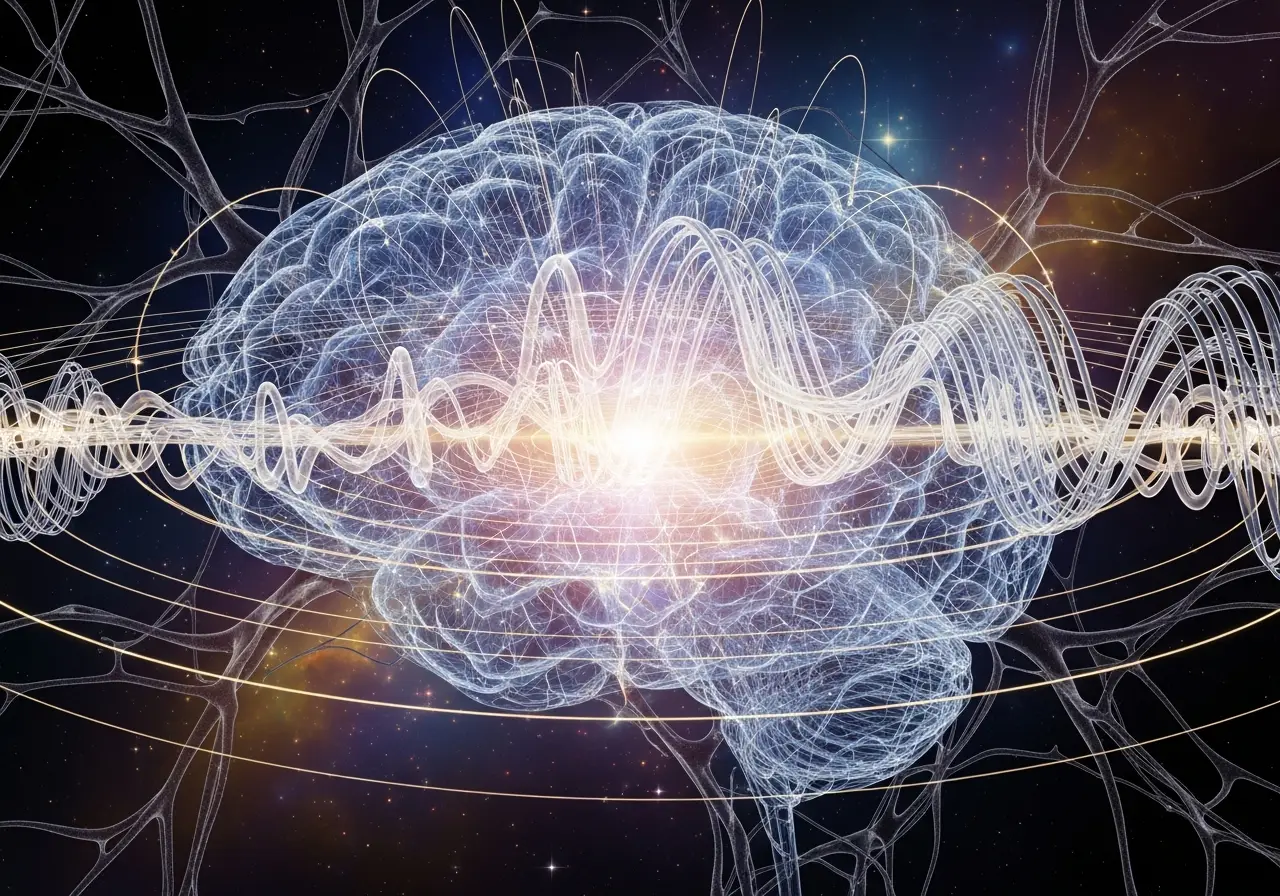
Orchestrated Objective Reduction (Orch-OR) offers a fresh narrative, proposing that quantum states within microtubules—the structures inside our neurons—collapse due to gravitational forces, not because they are observed. This perspective, advanced by Roger Penrose and Stuart Hameroff, reinvents our understanding by placing gravity at the heart of quantum mechanics, suggesting a reality guided by universal principles rather than individual awareness.
As we examine how microtubules might truly be the stage for these quantum events to play out, we’re invited to consider the more profound implications: that consciousness might arise not from mere psychological phenomena, but from the interplay between gravity and quantum mechanics. Suppose gravity orchestrates reality with the precision of a maestro leading an unseen symphony, guiding not only the cosmic but also the conscious.
Now, imagine the wide-reaching applications of Orch-OR—transforming how we perceive AI and technology by embedding quantum processes into their very fabric. This model suggests a future with machines that operate with a deeper integration into our universe’s laws, potentially leading to levels of interaction with reality far beyond current understanding.
Naturally, the scientific community approaches such revolutionary ideas with caution. Validating quantum phenomena can be elusive, and questions surrounding empirical evidence and philosophical implications abound. What does it mean if gravity, in shaping reality, supersedes conscious observation? Are we then passive recipients in a grand cosmic narrative?
Orch-OR encourages us to engage with cosmic mysteries through a new lens, blending science with philosophical musings. It invites us to reconsider the extent to which we understand the universe and our place within it—whether as observers or intrinsic participants in a grander scheme. As we explore this theory further, we delve not just into a realm of scientific discovery, but into an existential inquiry that challenges the boundaries of our knowledge and perception.
If you’re intrigued by the possibilities Orch-OR presents, consider exploring further—beyond merely accepting or dismissing this theory, it’s an invitation to engage with the universe on a more profound level, inviting us to question, discover, and expand the very notion of reality itself.