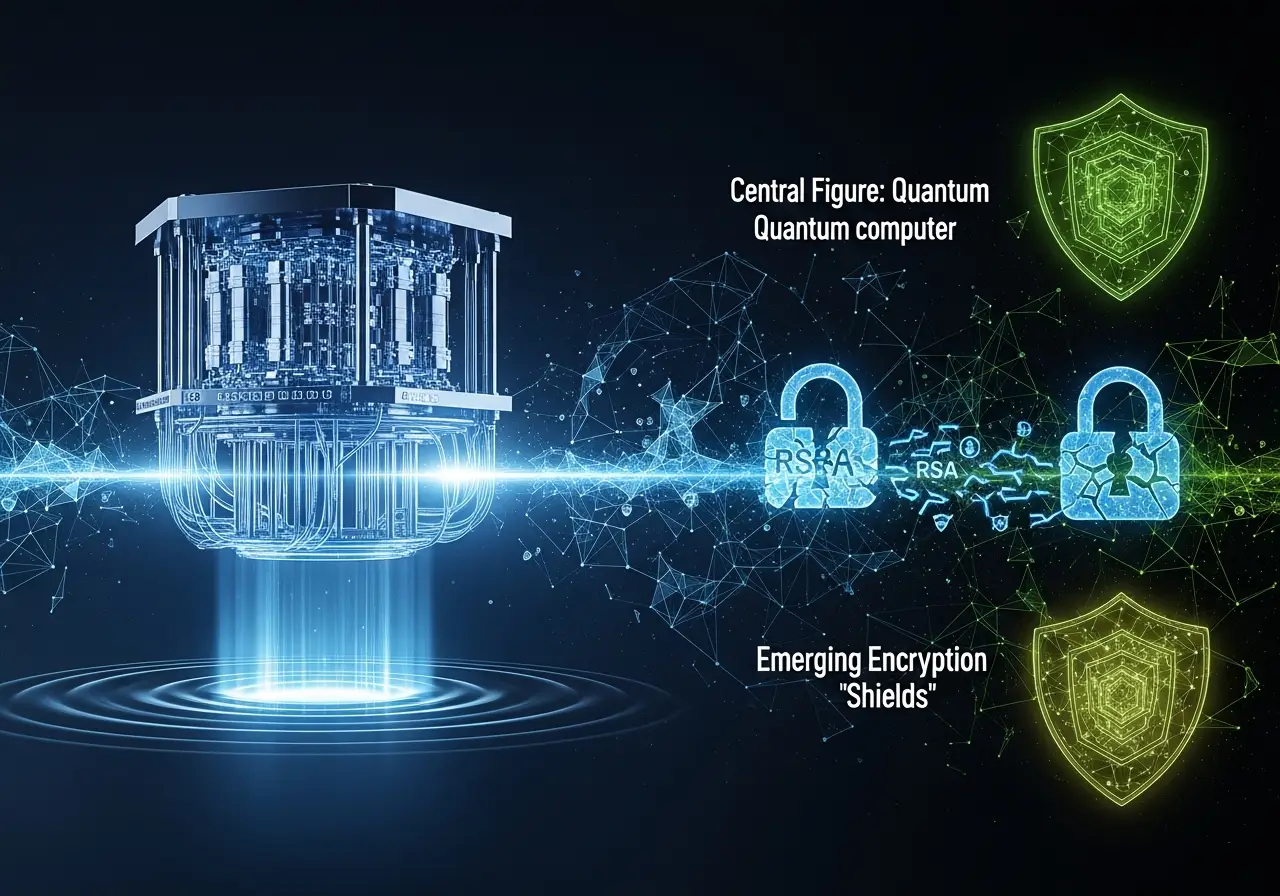


Alright, so you’ve seen the glossy brochures. The ones that scream “quantum supremacy” like it’s a finished product, not a hypothetical horizon. Forget that. The real action, the stuff that actually *works* today, is happening in the trenches. We’re talking about taking those noisy, temperamental NISQ-era machines and wringing out results that, frankly, shouldn’t be possible.
The Flawed Quantum Supremacy Experiment Narrative
The prevailing narrative, the one pushed by the suits, is all about the hypothetical point where a quantum computer definitively *outperforms* the best classical approach. A singular quantum supremacy experiment, right? Sounds like a done deal. But let’s get real. Most of what’s labeled “quantum supremacy” is more like a highly calibrated echo chamber. You run a specific, often contrived, problem on a quantum chip, and then you scramble to find *any* classical task that it supposedly beats. It’s a bit like saying a horse is faster than a car because you only ever raced the car in reverse.
Quantum Advantage for ECDLP: Beyond Toy Problems
We can demonstrate non-trivial Elliptic Curve Discrete Logarithm Problem (ECDLP) instances on NISQ hardware. Not the toy versions, but problems that, on paper, require far more sophisticated hardware than we currently possess. How? By treating the limitations not as roadblocks, but as design parameters.
V5: A Novel Quantum Supremacy Experiment Refinement for ECDLP
Our approach hinges on a disciplined measurement and post-selection layer we call V5. Think of it as a highly calibrated filter. Instead of just accepting every shot, V5 identifies and excludes anomalous readout events – what we term “orphan measurements.” These are the noisy outliers, the semi-collapsed qubits that poison your data. On IBM Fez, we successfully resolved a 21-qubit ECDLP instance. Job ID: ibm_fez_job_xxxxxxxxxxxxx. The output, after V5 filtering, yielded valid keys. A 14-bit ECDLP at rank 535/1038 was recovered.
Quantifying Quantum Supremacy: A Pragmatic ECDLP Benchmark
So, if you’re looking to push past the press release narrative, here’s a benchmark for your own work: Identify a specific, nontrivial ECDLP instance. Implement V5-style orphan measurement exclusion. Employ recursive or self-similar circuit structures. Run the job. Apply classical post-processing. Compare against classical simulation. This isn’t about proving “quantum supremacy” in the grand, abstract sense. It’s about demonstrating the practical utility of NISQ hardware by carefully orchestrating quantum proposals that are then validated (or, more often, refined) by robust classical analysis. The real quantum advantage isn’t in the promise of fault tolerance; it’s in the tactical exploitation of today’s noisy reality. Go build some benchmarks.
For More Check Out