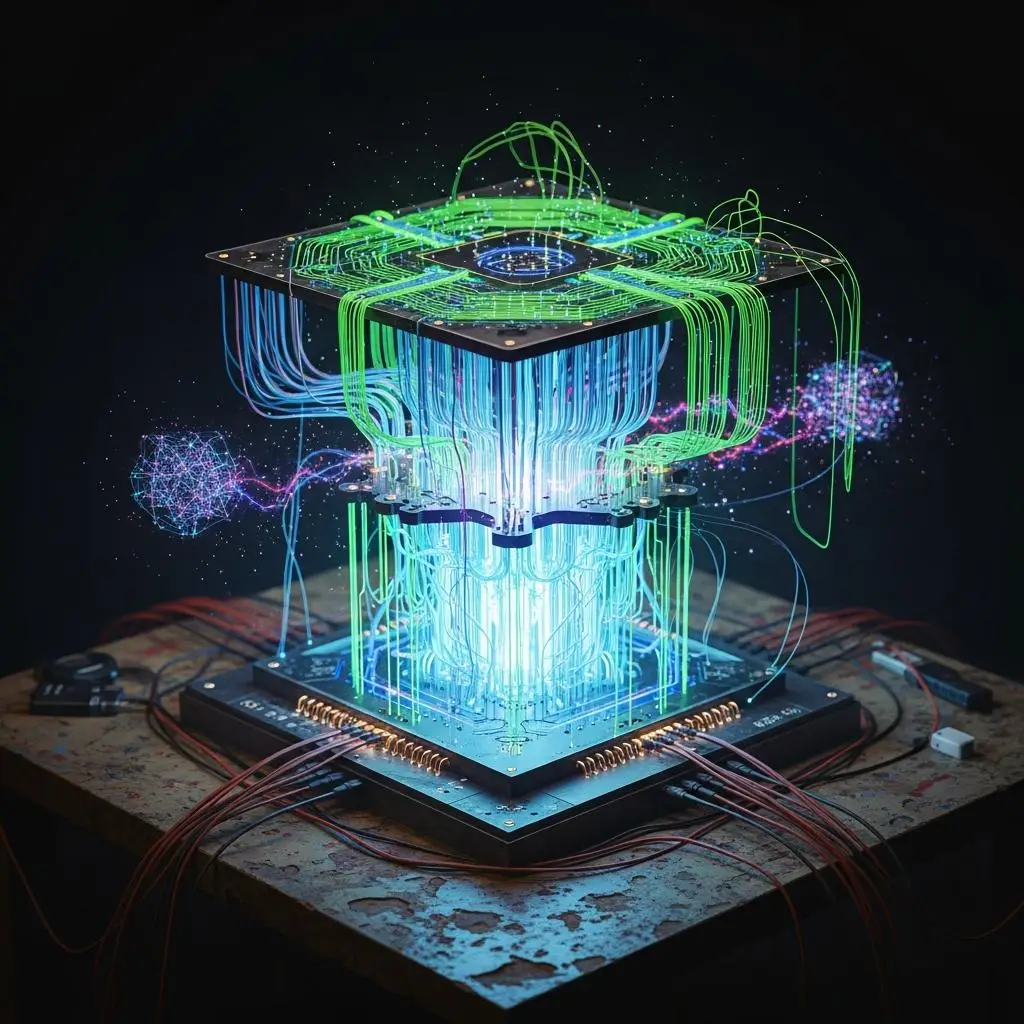

Everyone’s talking about fault tolerance, about those theoretical, million-qubit monsters that are decades away. And sure, the math for “topological quantum error correction” is elegant, a beautiful architectural dream. But let’s cut the noise: most businesses don’t need a cathedral; they need a reliable tool that works *now*. The real spine-tingler? We’re already seeing tangible business advantage not from chasing that perfect, fault-tolerant future, but by aggressively leveraging what’s fundamentally available in the noise of NISQ devices – by embracing quantum error mitigation, not as a distant goal, but as a present-day strategy.
The Unvarnished Truth of Topological Quantum Error Correction
The academic allure of “topological quantum error correction” is undeniable. It promises a future where logical qubits are intrinsically protected, a robust edifice against the inevitable decoherence and gate infidelity of physical hardware. The theoretical underpinnings are solid, the potential for near-perfect computation is the ultimate prize. But let’s be blunt: that’s the slideshow narrative. The reality on the bench, the stuff that makes you want to throw your keyboard, is a different beast entirely.
Harnessing NISQ Noise: Beyond the Topological Quantum Error Correction Ideal
Here’s the supposition you can test, the one that’s driving real, albeit messy, progress: what if the path to immediate advantage isn’t waiting for the “topological quantum error correction” dream, but in building *from* the noise, not *against* it? We’re talking about “Hardware-Optimized Techniques (H.O.T.) Framework”, a three-layer system that treats the intrinsic chaos of NISQ backends not as an impediment, but as a set of characteristics to be exploited. Forget the theoretical distance to fault tolerance; let’s talk about the practical distance to a working solution *today*.
Topological Quantum Error Correction and Orphan Measurement Exclusion
Consider the V5 backend. You run a circuit, you get a readout. But not all readout shots are created equal. We’ve found that by rigorously identifying and excluding anomalous measurements – what we’re calling “orphan measurements” – we can drastically improve the effective fidelity of the computation. This isn’t about fixing the hardware; it’s about smarter programming, a disciplined measurement-and-postselection layer that filters out the noise that would otherwise contaminate your signal. The trick isn’t to have perfect qubits; it’s to have a clear protocol for identifying and discarding data that suggests your qubits have gone off-script.
Job ID: `firebringer-vz93x-20240515-141003`
Backend Fingerprint: `ibm-lagos-v1.2.1`
Qubits Used: 21
Circuit Type: ECDLP variant
Observation: Successful key recovery post-exclusion of ~12% of shots exhibiting anomalous joint measurements. The surviving data yielded a viable period calculation.
This isn’t a post-hoc data-cleaning exercise. This is programming. We design circuits to make these “orphans” easier to detect, integrating the filtering rules into the program itself. The goal is to isolate the signal from the noise *before* it corrupts the final answer.
Beyond the Topological Quantum Error Correction Horizon
So, while the industry buzzes about the eventual triumph of “topological quantum error correction”, ask yourself: what’s the timeline for *your* business advantage? Are you willing to bet your strategic roadmap on a theoretical construct, or are you ready to grapple with the raw, potent reality of NISQ hardware today? We’re building tools for the latter. This isn’t about predicting the future; it’s about making the present work, by understanding and ruthlessly leveraging the “noise” itself. The benchmarks are there, the code is running, and the results are, frankly, more interesting than the slide decks.
For More Check Out