
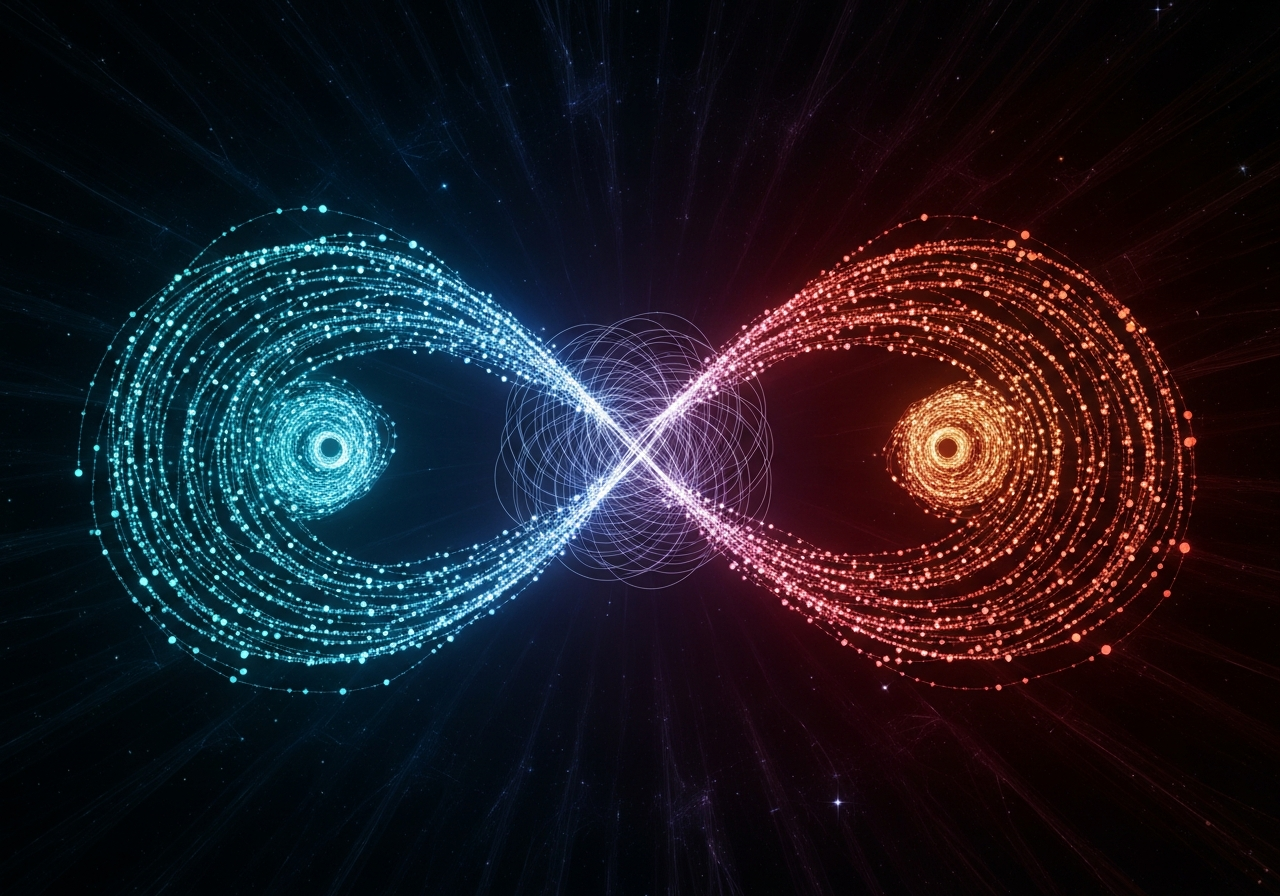

In a universe that defies our conventional understanding and dances at the whim of interconnected forces, everything you thought you knew about reality may be called into question. Bell’s Theorem, a groundbreaking revelation in quantum physics, exposes the intricacy of our universe where particles communicate across vast distances, challenging the very fabric of local realism—a concept long held dear by Western physics.
Imagine particles engaged in a cosmic dialogue, influencing each other instantaneously regardless of the miles that separate them. Bell’s Theorem invites us to unravel the mysteries of quantum entanglement, where the fate of one particle is intimately linked to another, miles away. It’s not about magic or paranormal phenomena, but rather about understanding the unique dance of quantum non-locality that reshapes our perspective on separation and individuality.
When you delve into Bell’s work, you’re not just exploring quantum mechanics; you’re stepping into a world where observation directly influences reality. Imagine how profound this is—not only in terms of physics but in how we perceive consciousness and choice. Every thought, every observation, potentially nudges the fabric of reality, prompting us to consider our role in an interconnected universe.
Einstein’s skepticism about “spooky action at a distance” captures a natural curiosity we’ve all felt—a recognition of invisible ties that bind us, much like thinking of a friend only for them to reach out moments later. Bell’s Theorem suggests that these connections aren’t mere coincidences but fundamental to the world’s structure. It’s a wake-up call to see beyond the illusion of separation and acknowledge our part in a vast, unified tapestry.
This understanding isn’t destined to remain confined to academia. It’s a call to action, urging us to acknowledge our entangled existence and the impacts of our choices. If particles can effortlessly connect, then can we not extend this principle to our human relationships, bridging divides and fostering unity?
As you ponder Bell’s Theorem, consider the ways it might inspire cultural, philosophical, and personal growth. Use this insight to explore empathy, creativity, and collaboration, vital tools for a world seeking coherence. Embrace this chance to participate in a universe where reality isn’t just observed but actively shaped by our engagement. Are you prepared to step into this quantum realm and explore the potential of a universe interwoven with possibility?