
Imagine sunlight being more than just light but a life-giving force, intertwining with nature in ways that stretch beyond our usual understanding. Photosynthesis, a process we might think straightforward, is actually a spectacle of quantum mechanics at play. It turns out, plants don’t just convert sunlight to energy; they do so with an elegance that makes researchers pause in admiration. As scientists peer deeper into how plants manage this feat, they find that coherence among molecules enables them to utilize energy with exceptional grace, rewriting some of our fundamental assumptions about nature’s efficiency.
At the heart of this process is photosynthesis, a natural masterpiece where sunlight becomes chemical energy. This transformation isn’t orchestrated by simple reactions but by a team of proteins and pigments playing in perfect harmony. Recent studies suggest these molecular players aren’t just following classical physics—they’re dancing to the beat of quantum mechanics.
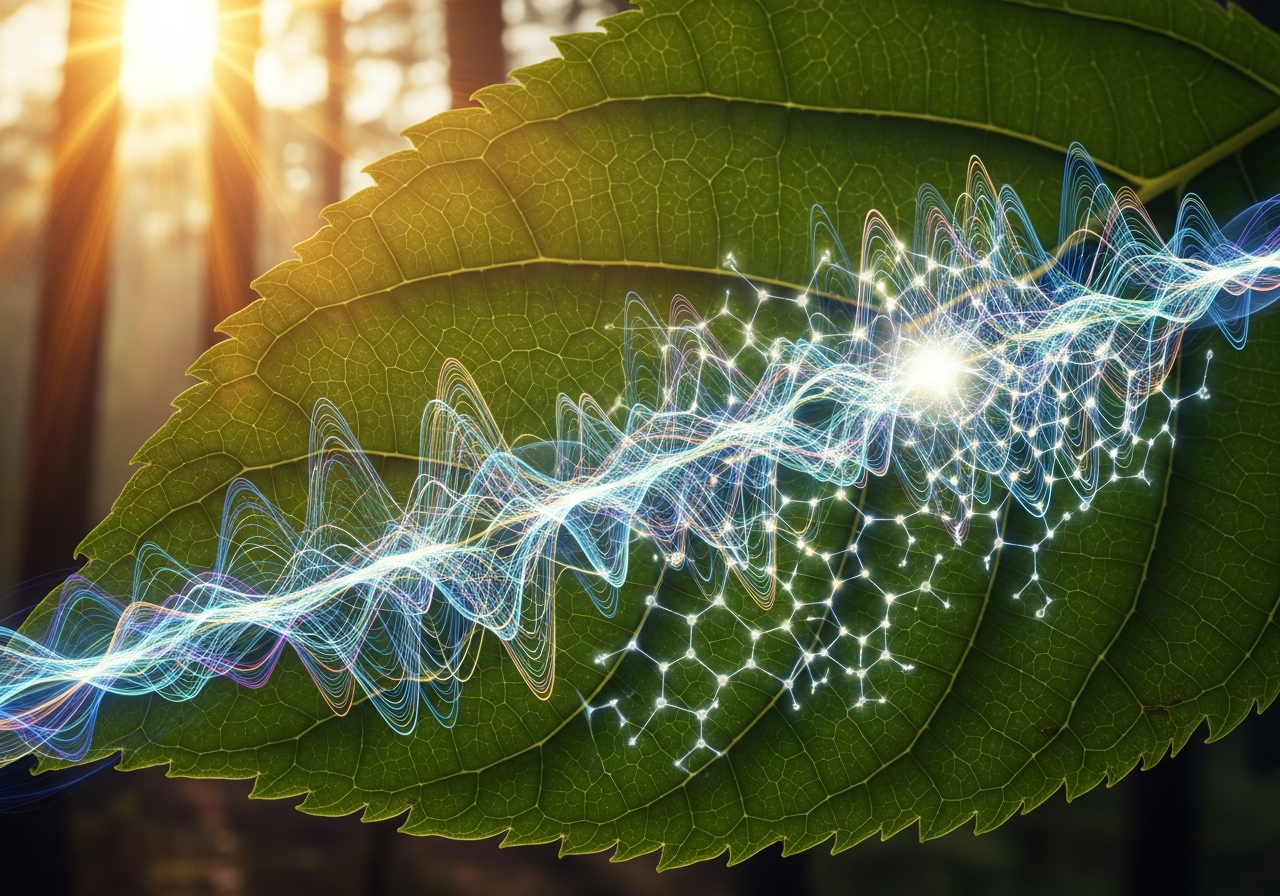
Consider coherence in photosynthesis. It’s like a finely-tuned orchestra where each musician—each molecule—plays in synchronicity. Chlorophyll molecules, for instance, vibrate together to maintain quantum coherence. This harmony ensures energy travels efficiently, like a skilled dancer finding the smoothest path to their partner, minimizing energy loss as heat along the way.
Traditionally, energy transfer in photosynthesis might resemble a game of hot potato, with energy zipping haphazardly until it’s used. Quantum coherence changes this game. Now, the energy flows more like an elegant dance, finding its way precisely and efficiently to where it’s needed—the reaction center, where it’s converted into chemical energy. This efficiency has researchers dreaming of solar panels inspired by these natural processes, potentially transforming our approach to energy systems.
But there’s more to this quantum tale. We delve into phenomena like entanglement—where particles are mysteriously linked, their states affecting each other regardless of distance. This has led researchers to explore whether such entangled states assist in the efficient coordination of energy within plant cells.
The implications of this quantum dance in photosynthesis provoke deeper questions. What does this say about life’s evolution on Earth? Nature has refined these mechanisms over billions of years. By studying them, we stand to learn about the foundational principles that steer the universe—a knowledge extending beyond plant biology to potentially groundbreaking innovations in synthetic life and energy harnessing.
Yet, this connection between quantum mechanics and biology is debated. Quantum behavior’s ‘weirdness’ can feel at odds with the familiar rhythms of daily life. Some remain skeptical, questioning the practical impacts of these findings. However, advancing technology continues to validate the role of quantum coherence in enhancing photosynthetic efficiency, shifting skepticism to cautious curiosity.
Each molecule in a leaf is part of a larger narrative about life’s interconnectedness and the universe’s principles. The revelations from quantum photosynthesis urge us past conventional biology and physics limits into a realm where life seems to resonate with the tenets of quantum mechanics.
Standing on the threshold of comprehending how photosynthesis achieves such remarkable efficiency, we’re drawn to appreciate the life complexities surrounding us. If sunlight can drive such exquisite processes at the quantum level, what other marvels might we discover just beyond our current grasp? The exploration of life’s secrets continues, as does our marveling at quantum coherence’s role in nature’s symphony. As we demystify quantum photosynthesis, we’re not only awed by nature’s ingenuity but also confronted with new understandings of life and energy. The cooperation of molecular coherence and energy transfer offers a blueprint for innovative energy solutions, compelling us to rethink sustainability. With such an elegant natural model, it’s no wonder that the potential to adopt these principles into technology feels not only exhilarating but necessary.