
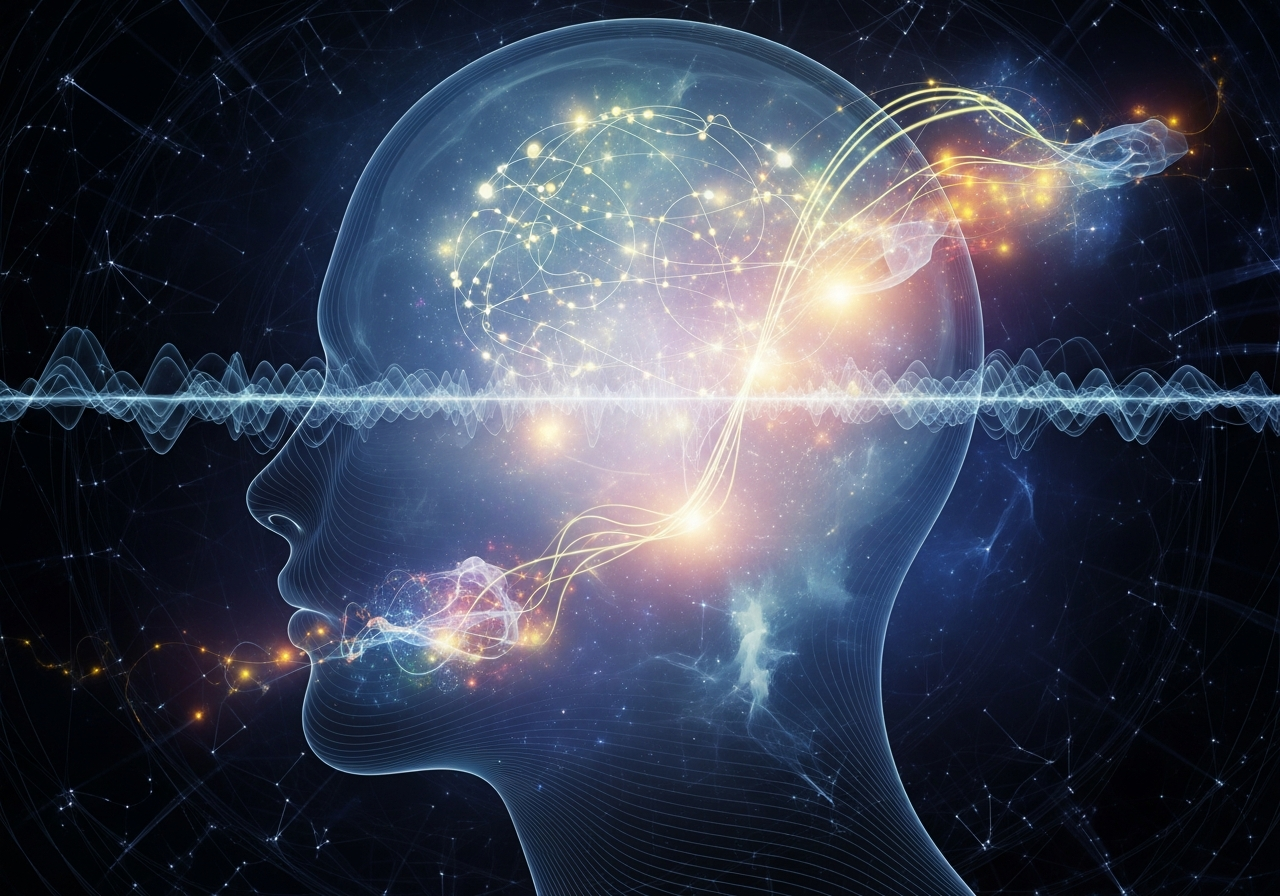

Peering into the depths of our minds reveals a complex interplay of thoughts and emotions, akin to a grand symphony of particles weaving the fabric of consciousness. Beneath our cognitive abilities, there’s a fascinating theory that quantum processes might orchestrate our perceptions and decision-making.
In exploring quantum cognition, we move beyond classical ideas of the mind as a precision machine, venturing into a realm where superposition and entanglement reshape our understanding. Consider, for instance, how tangled our emotions and memories can be, much like entangled particles resonating across time and space.
Reflect on those sudden insights or solutions to problems that strike without warning; superposition allows us to entertain multiple ideas simultaneously, waiting for the right moment when clarity emerges. This gives rise to ‘eureka’ moments where seemingly contradictory thoughts unite into one coherent solution, mirroring the dynamics of the quantum world.
When faced with decisions, our brains don’t settle on definitive outcomes but rather dwell in a state of possibilities until choices are solidified. The emotional states we experience further interact with our cognitive processes, where harmony leads to clarity, and discord can cloud our minds.
While this quantum lens offers intriguing insights, it’s essential to approach with care, balancing this exploration with empirical evidence and the reality of our neural structures. As we probe the link between quantum processes and consciousness, it raises questions not just scientifically, but philosophically about our role in shaping reality.
This journey into quantum cognition extends beyond academic exploration, inviting us to reconsider our very existence. Are we merely observers of pre-set rules, or do we actively sculpt our reality through our thoughts? As we contemplate these possibilities, we move closer to understanding what it truly means to think and feel in a dynamically intertwined universe.