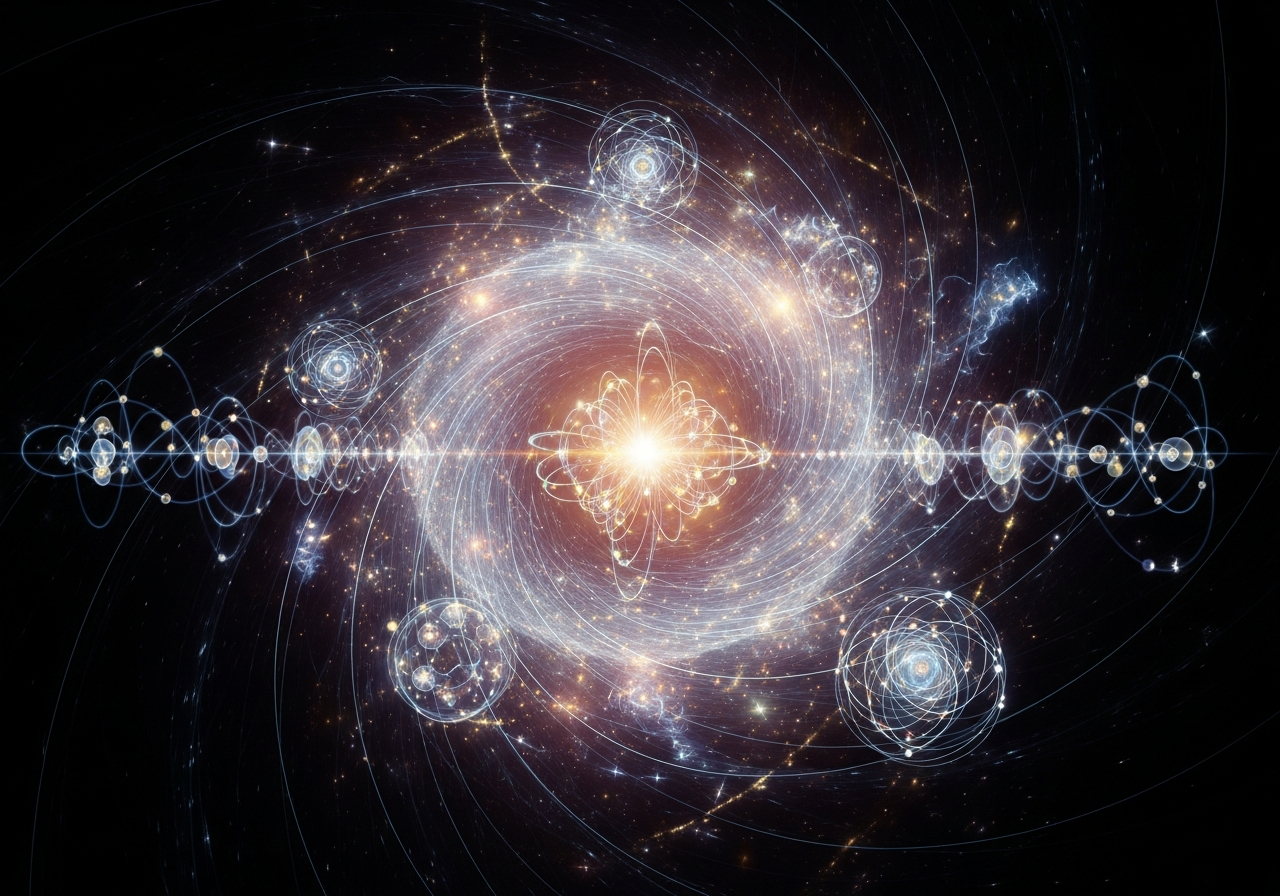

Stepping into the world of Objective Collapse Theory (OCT) feels like a venture beyond the ordinary play of chance and observation most associate with quantum mechanics. Imagine a universe where every decision and action ripple through the cosmos with tangible effects, not simply awaiting the nod of an observer to assert their reality—this is the territory OCT invites us into.
To grasp OCT, let’s first set the stage with quantum physics basics. In this realm, particles are not just static points but exist in states of probability. Envision them as dancers lured onto the dance floor, uncertain yet pulsating with potential movement. Traditional quantum mechanics asserts that these particles choose a definite dance only when observed. Yet, Objective Collapse Theory suggests a twist: it’s not purely our observation but inherent physical processes that nudge these particles into committing to a step.
Think of Objective Collapse as a cosmic clockwork—it’s not merely waiting for our gaze to fix its parts into place. Instead, the theory proposes that physical phenomena like mass and density could independently trigger a collapse, leading the universe towards concrete outcomes. The GRW model, a notable example, posits that reality doesn’t need our eyes to solidify—it does so through inbuilt cosmic regulations. It’s like watching a domino effect unfold, where the right conditions tip the scales, firmly setting things into motion.
The scale of interactions is critical here. Imagine tiny conversations escalating to a cacophony in a bustling crowd. Similarly, countless quantum flickers can collectively crescendo into a change. Physicists like Oliver Penrose even venture into gravity’s potential role as a catalyst for these collapses, hinting at an interconnected web between gravity and quantum tapestry.
So what does OCT spell for us? It suggests that reality is more than a stage where we passively watch acts unfold. We are engrained in its narrative—our every action and choice ripples with consequence, playing a part in this cosmic symphony. With advancements in fields like quantum computing, understanding these collapse mechanisms might carve new pathways. Our ability to predict and utilize these physical processes could herald innovations in how we manage information, both transferring and processing it with heightened accuracy.
In essence, OCT encourages us to perceive the universe not as an arbitrary assembly reacting to our curious eyes, but as a complex, self-regulating system. It entertains the profound possibility of our thoughts and actions being pivotal elements in sculpting reality. This challenges us to consider: are we mere passengers, or active creators, of the reality we experience?
As we contemplate this, one truth becomes evident: the universe thrives on an endless interplay of forces—forces we are intimately part of. Engage with it, and you’ll find yourself not only witnessing but shaping the quantum canvas that envelops us all. So, ready yourself to delve deeper and uncover the potential of your role in this vast quantum orchestra.