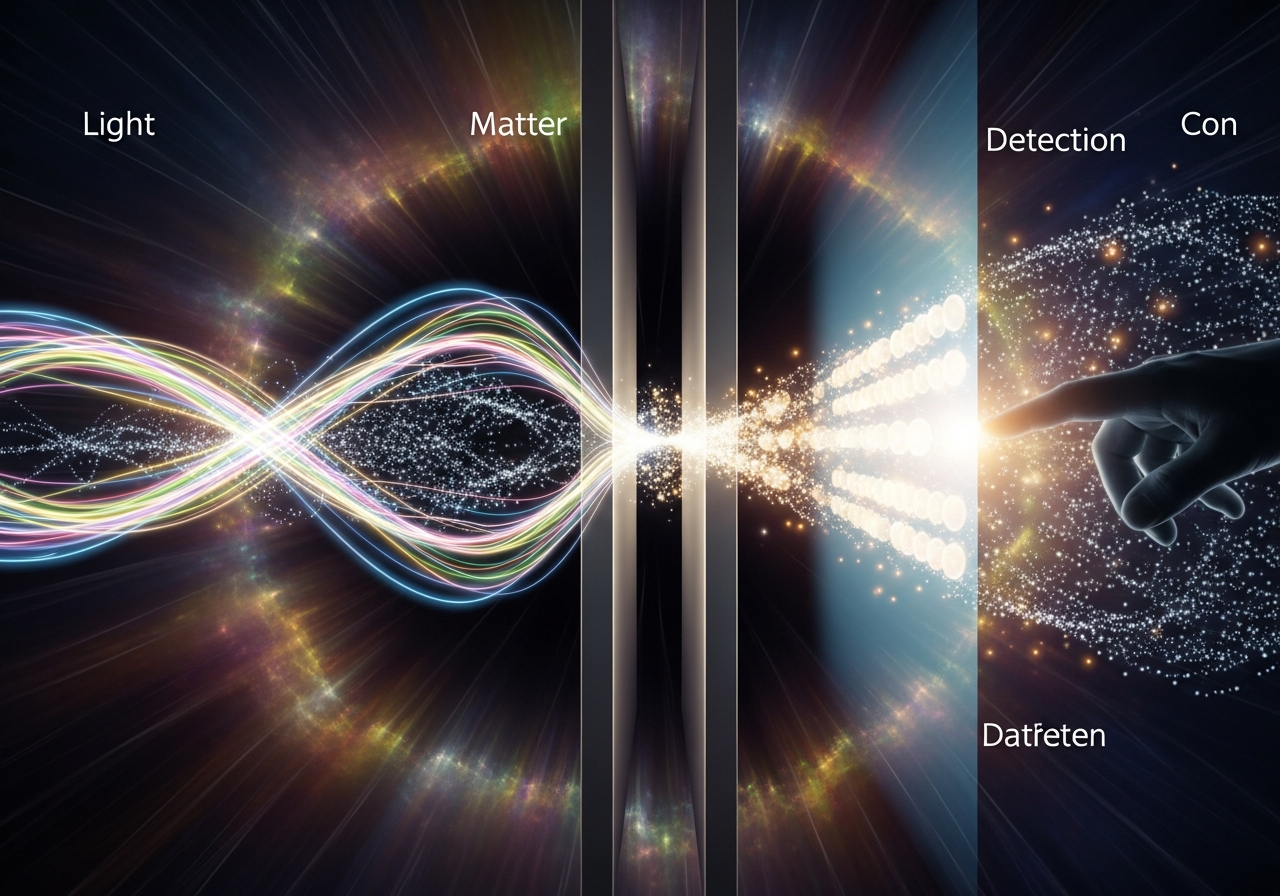

Standing at the edge of a vast, shimmering sea of quantum mysteries, we encounter the Complementarity Principle, a concept at the heart of quantum mechanics that challenges our everyday perceptions. This principle reveals the dual nature of light and matter — sometimes behaving like waves, other times as particles — depending on how we choose to observe them. It’s much like looking at a piece of art, where one moment can spark joy and the next, perplexity, all shaped by our own background and expectations.
This interplay is beautifully illustrated in the famed double-slit experiment. Picture firing particles at a barrier with two openings. When unobserved, they create patterns that suggest they pass through both slits simultaneously, behaving like waves. Yet, once you observe them, they suddenly act like particles, choosing one path over another. It’s a reminder that observation itself can shape reality, that our thoughts and perceptions play an active role in what we experience.
But let’s go further. The idea that coherence — the alignment of particles into a unified state — is context-dependent mirrors our own experiences. We encompass both individuality and unity, depending on the circumstances. And just as particles reveal their true nature based on context, so our understanding of the world is deepened when we accept complexity instead of craving simplicity.
This paradox of quantum mechanics enlightens us not by providing definitive answers but by inviting us to explore how opposites can coexist. Much like the ocean’s waves mirror both serenity and turmoil, so too do quantum realities intertwine. It’s an invitation to embrace fluidity and uncertainty, recognizing that these elements drive creative thought and deeper comprehension.
In essence, the Complementarity Principle is a testament to the richness of existence. It encourages us to let go of rigid definitions and see the universe as a dynamic tapestry where every observation reshapes reality’s landscape. Each of us, with our questions and curiosities, is a participant in the cosmic dance, creating and recreating the world we live in. As you ponder these concepts, remember that you’re not just observing — you’re actively shaping the story of the universe itself.